Centre for Academic Development is a value-driven, technology-infused division conducting programmes and offering services that are responsive to the learning and teaching needs of VUT students and staff.
Start a conversation with our AI Chatbot
Click here to chat with me!
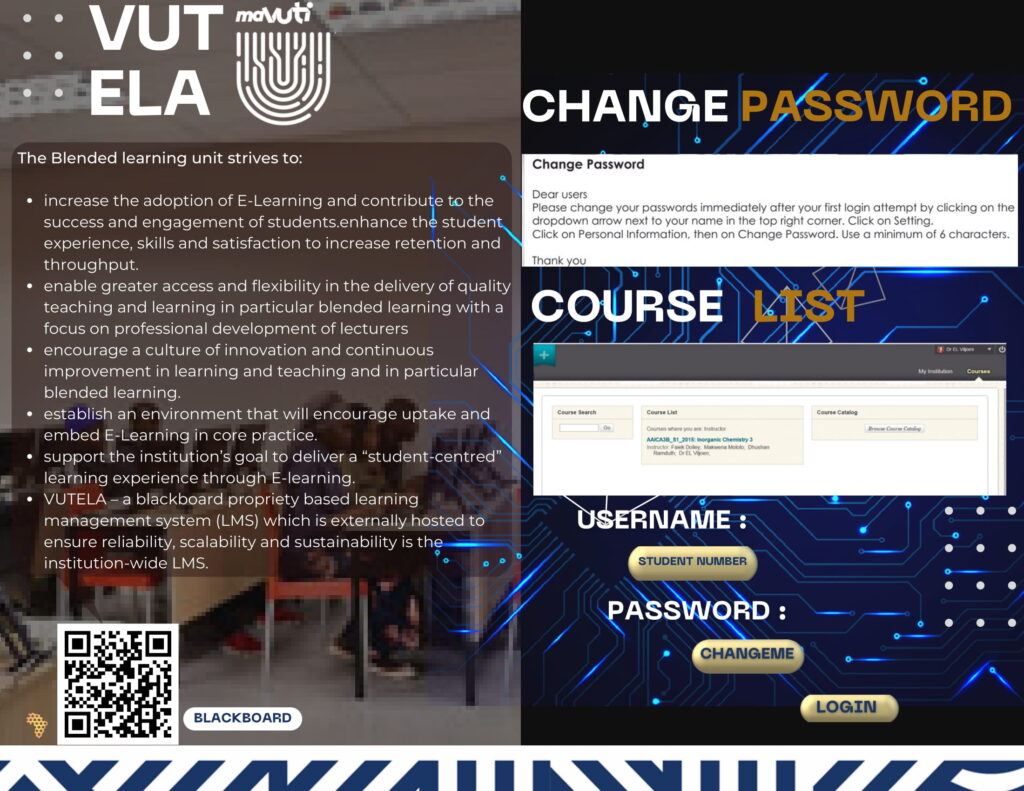
The Blended learning unit strives to:
Staff Members & Contacts :
To reach your academic and personal goals, the following services are available to assist with supporting and developing you during your first year of study:
During orientation, you are welcomed and introduced to the university environment. Student peer mentors from the mentorship or learning communities programme provide the guidance and psycho-social support you need. Peer mentors are senior students and role models with good academic performance and leadership qualities trained to guide you. A peer mentor from your field of study will be assigned to nurture you throughout your first year. Your unique needs are further addressed through seminars and workshops facilitated by the student academic advisors. Your first year at the VUT is geared towards providing opportunities to help you be at ease in your higher learning community and develop the courage, strength, and confidence to navigate your academic journey at VUT and beyond successfully.
Support for the FYE project to be visibly maintained at senior levels:
Enhancing responsibility at all Faculties and Departmental levels for improving the FYE, with emphasis on student- centred approaches to both teaching and administration;
Collaboration between academic and non-academic units to ensure an integrated approach to enhancing the student experience;
Enhanced collaboration between staff and students to address student needs; and
Sustained initiatives in continuous professional development of staff so that they develop skills of first year teachers and coordinators.
Staff Members & Contacts :
We’re here to support your academic journey. Whether you’re exploring majors, planning your courses, or looking for support, we are here to help you thrive.
“Academic advising is a shared responsibility. Your success is our mission.”
Our Services Include:
🧑🏽🏫 Advising Coordinator: Mr M Samosamo
📍 PS Building, 3rd Floor, Office 323
🕐 Hours: Mon–Fri, 07:30–16:30
📞 Office Number: 0169507734




Student Mentor Programme aim to provide peer support that enhances students’ academic, personal and social wellbeing during first year of study.
First-year students participating in this programme are assigned mentors (senior students), who’s duty is to foster the development of learning communities with first-year students studying similar courses to help them adjust successfully to university.
As such, Learning Communities play a key role in first-year students transition process, enhancing their educational effectiveness, and success through engaging them in educationally purposeful activities outside of the class.
Student Mentorship Programme occurs as follows:
🧑🏽🏫 MR. MOTHUSI SAMOSAMO
📞 Office Number: 016 950 7734
The Mathematics, Science, Engineering and Technology (MSET) Centre is aimed at helping students who are experiencing challenges with mathematics, chemistry, physics, and mechanics and/or want to deepen their knowledge and understanding of these subjects as well as to enhancing their performance
OUR SERVICES
CONTACTS
We are located at the Y-building next to the Sports and Recreation Centre
🧑🏽🏫 Dr MG Peleyeju
📞 Office Number: 0169507559
📧 E-Mail: mosesp@vut.ac.za
🧑🏽🏫 Mr Kabelo Raselabe
📞 Office Number: 0169507644
📧 E-Mail: kabelor@vut.ac.za
Co-operative Education facilitates a unique learning experience which delivers a specific type and level of knowledge, understanding and skills development through learning by applying theory in practice. The University partners with Industry in order to facilitate this unique learning process.
Co-operative Education is the umbrella term that is used to summarise all activities such as placement of WIL students, Internship, etc. Work Integrated Learning as a pedagogy of learning consist of different modalities. In VUT, Workplace Based Learning is used as a compulsory modality in most disciplines offered.
STRATEGIC GOAL, OBJECTIVES & PRIORITIES
Co-operative Education is aligned with the University’s strategic objective 1: Techno-Entrepreneurial Graduates and Innovation: Quality student experience. The strategic priorities of Co-operative Education are placement of students, forging relationships with industry, seeking funding of students, as well as seeking strategic partnerships and preparation of students for the real world of work.
VISION
Co-operative Education aligned its Vison and Mission with the Vision and Mission of VUT. Co-operative Education’s Vision is to provide Co-operative Education services to the students to enhance their employability in the industry and entrepreneurship capabilities.
MISSION
To promote and extend the academic learning process into the workplace through Co-operative Education for the benefit of employers, students and the University by:
VALUES
SERVICES OFFERED
CONTACTS
N-BLOCK (First Floor) N108 – above the Clinic
Office of the Director (Dr A Moletsane): 016 950 9137
Administrator to the Director (Ms L Dreyer): 016 950 9372
Industry Liaison Practitioners: 016 950 9151 / 9343 / 9804
Database Coordinator (Mrs P Madlodlo): 016 950 9707
WIL Administration: (Mrs C Dos Santos): 016 950 9161
Information Coordinator: (Mrs S Mkhwanazi): 016 950 9457
Main Reception: 016 950 9496 / 9522 / 9388
Social Media
Facebook – VUT Co-op
Twitter – @VUT_Cooperative
LinkedIn – VUT_Cooperative Education Department
Follow the link for more information
The VUT E-Skills CoLab is responsible for skilling, up-skilling, and re-skilling of citizens in digital skills through various training programmes. Due to the e-readiness rankings of South Africa, which improved slightly over the last few years, this digital skills programme is an essential tool to contribute to the growth of the ranking and give citizens the skills to participate in the digital economy of South Africa.
The CoLab offers basic to advanced digital literacy skills. The basic skills include computer and mobile literacy. The advanced courses include web development, data science and many other technical proficiencies through its partnership with the National Electronic Media Institute of South Africa (NEMISA).
The CoLab also has an exciting focus on ICT business Development through our ICT Technical courses including Cell Phone Repairs, DTT, Web and App development, Fibre optics, WISP and others. We equip our participants with the necessary knowledge, skills and tools to start their businesses within the ICT space in their communities.
Use your leisure time as an opportunity to invest in yourself, by equipping yourself with the tools to thrive in an increasingly digitalized society.
The Writing Centre is a place where students of all disciplines and writing abilities can discuss their writing, with a postgraduate writing consultant. Using approaches which promote conversation and inquiry in on-to-one and small group consultation. The Writing Centre helps you to become more active in conceptualizing and improving your writing.
Main aims of the Writing Centre:
🧑🏽🏫 MS. INNOCENTIA SHUBE
📍 PS Building,2nd Floor PS 209
📞 Office Number: 016 950 9698
📧 E-Mail: writinglab@vut.ac.za
A strategic Unit of the University that focuses on the development of African languages in different forms within VUT. The Unit also facilitates the implementation of the VUT Language Policy. Although the Unit does not deal directly with students, they are however encouraged to contact the Unit whenever they need assistance that is African languages related.
Language Services
The Unit coordinates and manages translation, language editing and interpreting services at VUT. We develop and produce glossaries for various courses in various disciplines and we also translate documents from English into the identified African languages. Furthermore, we also provide subtitles to video recorded lectures. The three most spoken languages on campus are Sesotho, Sepedi and isiZulu. The university is currently developing Sesotho and Sepedi languages. However, it should be noted that isiZulu and other African languages will be added once resources are available. We build Sepedi and Sesotho terminology databases and authenticate these through our collaboration with other universities and language interest bodies/organisations. This is our attempt to develop these indigenous languages to the level of operation enjoyed by both English and Afrikaans.
Language Policy Implementation Strategy
The Unit is tasked to draft a Language Policy Implementation Strategy and drive the implementation processes across the entire University. Key to our mandate is assisting the University faculties, divisions, and departments in complying with the VUT Language Policy.
🧑🏽🏫 MS. Millicent Seripe
📞 Office Number: 016 950 6960
The Vaal University of Technology (VUT) eLearning Department provides academic support services, professional development, and technical assistance to ensure the effective integration of technology in delivering high-quality courses. This initiative is aligned with the VUT Strategy 2033+ vision of fostering “learning and innovation for a digitally smart and sustainable industrial progress and socio-economic transformation”.
Through collaborative partnerships, the department leverages innovative technologies such as:
These tools are instrumental in improving student learning experiences, promoting active engagement, and preparing graduates for a competitive, tech- driven future.
📞 Office Number: 016 950 7738
📧 E-Mail: elearning@vut.ac.za




 Facebook: VUT E-Skills
 E-Mail: