
“Meet Ms Nomonde Mdlokovana, a master’s graduate in Supply Chain Management at VUT, whose research on sustainability and reverse logistics reflects the University’s 60th milestone season.”
05 May 2026 | Story by: Shaun Michael Ndou | Picture: Keitumetsi Mokgope
3 minutes read time.
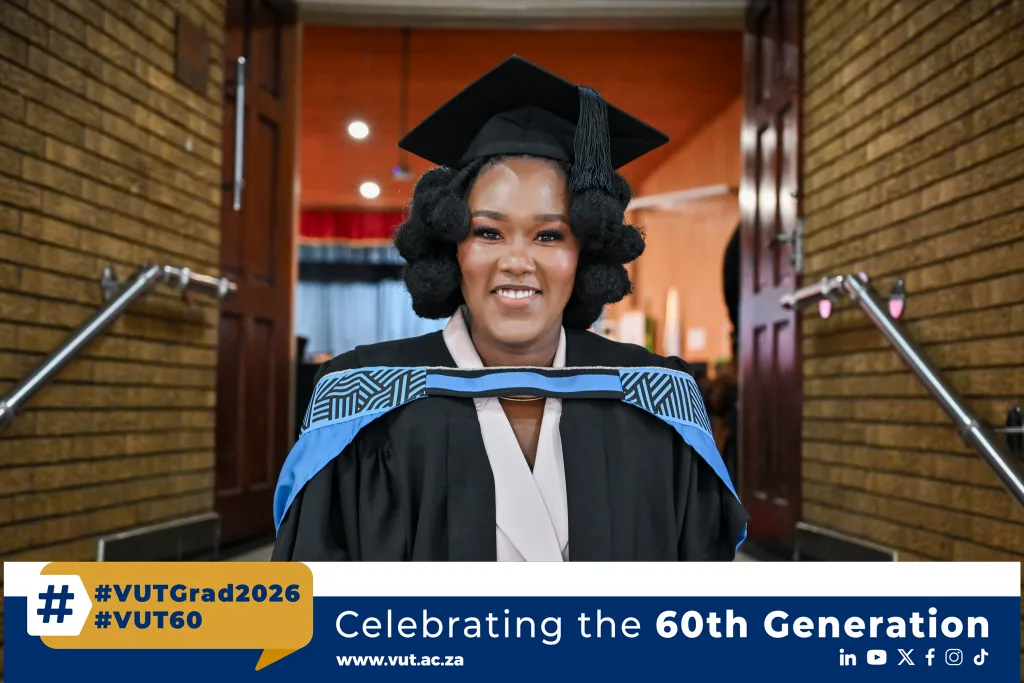
As the Vaal University of Technology (VUT) marks its 60th milestone season, its story is not only told through numbers and ceremonies, but through the lives of graduates who carry its purpose into the world. Among those who walked the stage on 24 April 2026 was Ms Nomonde Mdlokovana, who completed her Master of Management in Supply Chain Management, a qualification shaped by both intellectual rigour and a deep sense of responsibility to the environment.
Originally from Lesotho, Ms Mdlokovana’s academic journey was never simply about advancing her career. It was about answering a question that continues to echo across industries and borders: how can supply chains, often associated with consumption and waste, become instruments of sustainability? Her pursuit of a master’s degree became the bridge between her corporate experience and a more reflective, research-driven understanding of the field.
“I believe that going green is the new okay,” she said, her words carrying both conviction and urgency. “I wanted to focus on a body of work that guides how to go about it. We have a significant waste problem, and not enough attention is given to reverse logistics. My thesis encourages using these systems to take care of the environment.”
Her research, centred on reverse logistics, speaks to a growing global imperative to rethink how products move beyond their initial use. It is a call to redesign systems so that waste is not the end of the story, but the beginning of renewal. In this, her work aligns with a broader shift towards circular economies, where sustainability is no longer an afterthought but a defining principle.
The path to this achievement, however, was not without its trials. Transitioning from undergraduate studies in Logistics to the demands of postgraduate research required a new level of discipline and resilience. Data analysis and statistics, she admits, presented moments of doubt. Yet, in those moments, support became the difference between hesitation and progress. Under the guidance of her supervisor, Dr Van der Westhuizen, she
found both academic direction and encouragement. Financial support through the VUT Award further eased the burden, allowing her to focus on the work that mattered most.
Reflecting on her time at the University, Ms Mdlokovana speaks with clarity about what sets VUT apart. It was the institution’s emphasis on Work-Integrated Learning (WIL) that first drew her in, a promise that education would not remain confined to lecture halls but would find expression in real-world application. “It ensures that you are not just a holder of a paper,” she explained, “but someone who is ready to contribute meaningfully in the workplace.”
That philosophy continues to shape her aspirations. While she currently operates within the corporate environment, her gaze is firmly set on the lecture hall. She envisions a future where she can guide emerging professionals, bringing lived experience into academic spaces. “The best lecturers are those who have actually worked and seen the workspace instead of just being theory-based,” she said, reflecting a belief that knowledge must remain connected to practice.
Her journey, quietly powerful, mirrors the ethos of a University that has spent six decades evolving with the needs of society. As VUT reflects on its legacy, it is graduates like Ms Mdlokovana who give that legacy meaning, individuals who understand that progress is not only measured in economic terms, but in the sustainability of the systems we build.
In celebrating her achievement, the University does more than confer a degree. It affirms a vision of leadership that is conscious, informed, and forward-looking. In a world grappling with environmental strain, Ms Mdlokovana’s work stands as a reminder that the future of supply chains, and indeed the future of industry itself, will depend on those willing to rethink, redesign, and restore.