
“Professor Fanyana Mtunzi of Vaal University of Technology (VUT) highlighted the continued relevance of medicinal plants in modern healthcare in his inaugural lecture, showcasing innovative research in drug discovery, nanoscience, and community-based healthcare solutions.”
12 May 2026 | Story by: Nontobeko Moimane | Picture: Keitumetsi Mokgope
5 minutes read time.
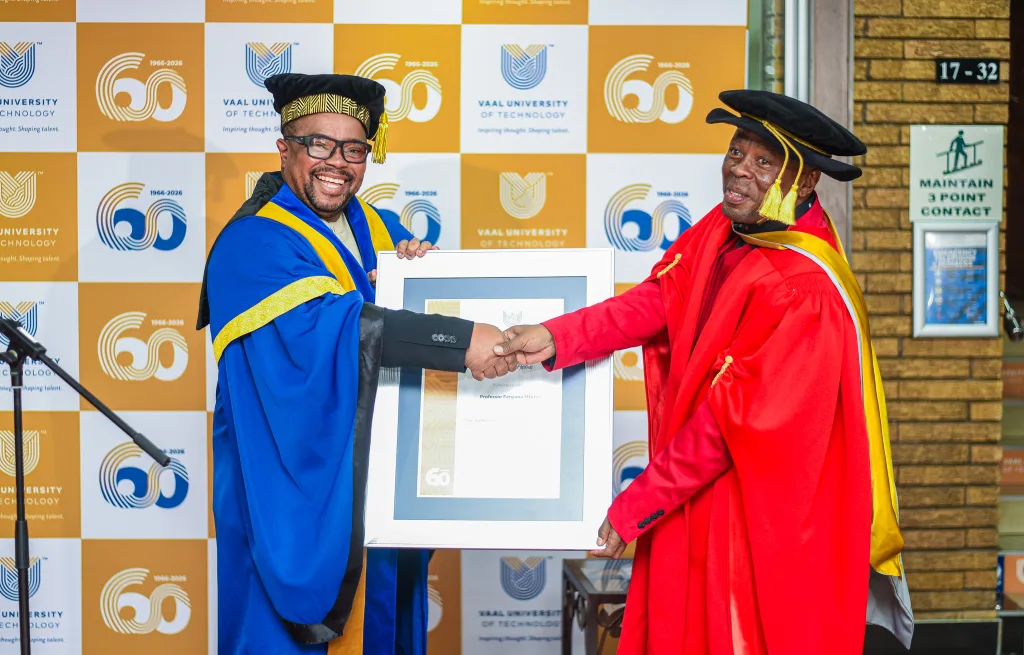
The atmosphere inside the Desmond Tutu Foyer at the Vaal University of Technology was filled with pride, curiosity and intellectual energy as academics, students, researchers, family members and invited guests gathered for the inaugural lecture of newly appointed full professor, Professor Fanyana Mtunzi. Held on 06 March 2026, the occasion became more than a ceremonial academic milestone. It evolved into a powerful reflection on the intersection between African indigenous knowledge, scientific innovation and the future of healthcare.
Delivering his lecture under the thought-provoking theme, “Are Medicinal Plants Still Relevant in Today’s World?”, Professor Mtunzi challenged the assumption that traditional medicine belongs only to the past. Instead, he presented a compelling case for why medicinal plants remain central to modern healthcare, scientific advancement and sustainable development.
From the outset, the evening carried a deeper meaning. It celebrated not only academic excellence, but also research with purpose, research capable of changing lives beyond the walls of laboratories and lecture halls.
Opening the programme, Professor Solly Lebelo reflected on the importance of making research accessible and meaningful beyond academic circles.
“Today we want to hear what Professor Mtunzi is doing in a simpler way that will motivate us and help us understand,” he said. “Research should not remain hidden in papers and journals. It must inspire society.”
Welcoming guests to the occasion, Acting Executive Dean of the Faculty of Applied and Computer Sciences, Dr Nolutho Mkhumbeni, described inaugural lectures as an important academic tradition that celebrates intellectual leadership and scholarly excellence.
Reflecting on Professor Mtunzi’s academic journey, she highlighted his more than 160 peer reviewed publications, over 2,600 citations and the supervision of numerous postgraduate students.
“Today we celebrate not only the appointment of Professor Mtunzi as a full professor, but also what this appointment represents, excellence in scholarship, leadership in research, dedication to mentorship and service to society,” she said.
She further noted that Professor Mtunzi’s research in phytochemistry, drug discovery and nanoscience continues to address pressing global healthcare challenges while advancing innovation rooted in African knowledge system
At the centre of Professor Mtunzi’s lecture was a simple but powerful message: medicinal plants remain indispensable in the modern world. Speaking passionately about the value of traditional medicine, he argued that medicinal plants continue to hold scientific, social, economic and cultural significance despite rapid advances in biotechnology, pharmaceutical sciences and artificial intelligence.
“Medicinal plants are not only relevant; they remain scientifically, socially, economically and culturally indispensable,” Professor Mtunzi said.
Using examples such as aspirin, originally derived from willow bark, and artemisinin used in malaria treatment, he demonstrated how plant-based medicine has long influenced modern pharmaceuticals and continues to shape future healthcare solutions.
The lecture also offered insight into the innovative work emerging from his research group at VUT. Among the projects highlighted were mosquito repellent textiles infused with plant oils, fluorescent livestock sprays designed to improve road visibility in rural communities, and plant-based products developed through partnerships with entrepreneurs and traditional healers.
Throughout the evening, one idea echoed consistently: research must matter to ordinary people.
Professor Mtunzi also spoke strongly about the importance of translational research, the kind of research that moves beyond academic shelves to create tangible social impact.
“We no longer want research that sits in the library where nobody sees it,” he explained. “As a university, our mandate is to ensure that what we do changes people’s lives.”
Equally important was his call for the scientific validation of traditional medicine. He stressed the need for rigorous research to ensure safety, effectiveness and proper dosing, while also protecting indigenous knowledge systems from exploitation and misinformation. According to Professor Mtunzi, combining indigenous wisdom with scientific methods could unlock entirely new healthcare possibilities for future generations.
Responding to the lecture, Professor Michael Pillay from the University of South Africa praised Professor Mtunzi for demonstrating that traditional medicine and modern science are not opposing forces, but complementary systems capable of working together to solve healthcare challenges. He noted that medicinal plants continue to play a vital role in improving healthcare accessibility and affordability, particularly within developing regions.
Deputy Vice Chancellor for Research, Innovation, Commercialisation and Internationalisation (RICI), Professor Simphiwe Nelana, reflected not only on Professor Mtunzi’s scholarly contribution, but also on his humility, mentorship and dedication to community engagement.
“What we witnessed today is excellence,” said Professor Nelana. “Professor Mtunzi is not only a researcher; he is a builder of people and systems. His work reminds us that scholarship is not only about discovery, but also about legacy.”
Reflecting on their professional relationship spanning nearly two decades, Professor Nelana noted that Professor Mtunzi’s work has helped shape and strengthen the research culture at VUT while contributing to changing perceptions about the institution’s academic excellence and innovation capacity.
“We want occasions like these to change the narrative about VUT and showcase the excellence that exists within this institution,” he added.
The evening concluded with the formal awarding of a certificate recognising Professor Mtunzi’s inaugural lecture and induction as a full professor at VUT. Yet as applause echoed through the venue, it became clear that the significance of the occasion stretched far beyond academic recognition alone.
It became a celebration of African knowledge systems, scientific discovery, mentorship and the enduring belief that research should serve humanity.
For the many students and emerging researchers in attendance, Professor Mtunzi’s journey stood as a reminder that impactful scholarship often begins with curiosity, purpose and a commitment to improving the lives of others