
“VUT’s Dr Luyanda Marhaya has been appointed as a Peer Academic by the Council on Higher Education to support quality reviews and strengthen academic standards.”
30 March 2026 | Story by: Nontobeko Moimane | Picture: Keitumetse Mokgope
4 minutes read time.
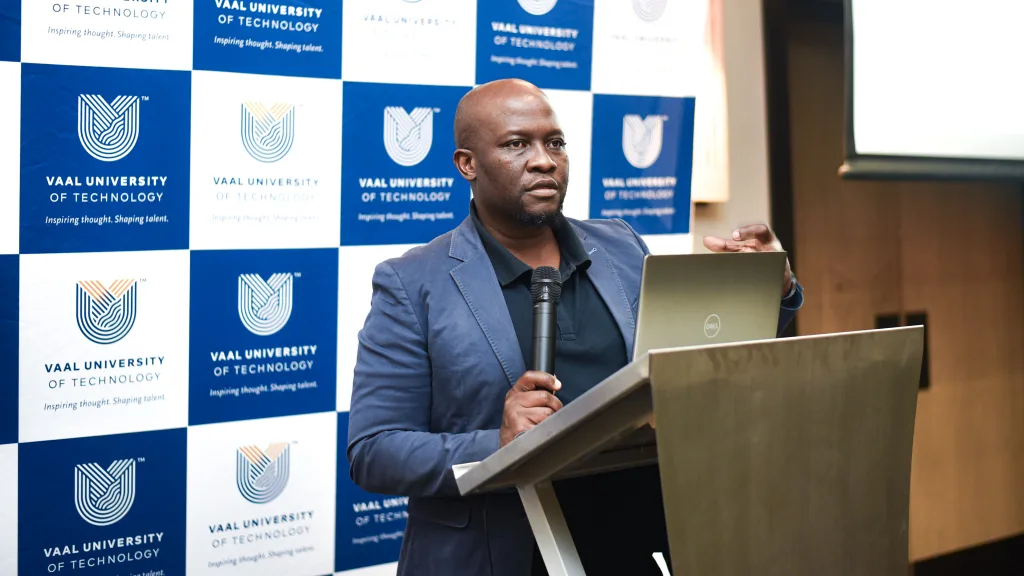
The Vaal University of Technology (VUT) continues to affirm its role in shaping the national higher education landscape, following the appointment of Dr Luyanda Marhaya as a Peer Academic for Quality Reviews by the Council on Higher Education (CHE).
Dr Marhaya, Director of the Programme Accreditation and Curriculum Development Department at VUT, joins a select cohort of experts entrusted with advancing quality assurance across South Africa’s higher education sector. The appointment, confirmed in an official communication from the CHE, reflects both his professional standing and the University’s growing influence in academic quality governance.
Established in terms of the Higher Education Act, the CHE serves as the statutory body responsible for quality assurance in higher education, operating through its Higher Education Quality Committee. Through this structure, it safeguards academic standards and promotes continuous institutional improvement across the sector.
Dr Marhaya brings extensive experience to the role, with a distinguished academic career spanning institutions including Walter Sisulu University, the University of Fort Hare, the University of Zululand, the University of Venda, and the University of the Free State. His expertise encompasses curriculum development, quality assurance, teaching and learning, and academic planning. Since 2024, he has served as Director: Programme Accreditation and Curriculum Development at VUT, further consolidating his contribution to the sector.
Reflecting on his journey into quality assurance, Dr Marhaya described it as both unexpected and transformative. “My interest in quality assurance developed during my postgraduate studies in Higher Education Studies, where I was introduced to the field. The experience shaped my academic practice and inspired me to support other academics in improving teaching and learning,” he said.
In his new role, Dr Marhaya will serve within an 11-member Community of Practice responsible for reviewing more than 70 higher education institutions nationwide. The reviews will focus on institutional readiness for online, blended, and hybrid learning models, an area that has gained increasing prominence in the post pandemic academic environment.
“The rapid transition to online learning exposed several gaps within the sector. This process is about identifying both strengths and areas for improvement to ensure that academic standards are maintained across institutions,” he explained.
Peer academics play a central role in the CHE’s review processes. Review panels assess institutional Self Evaluation Reports and supporting evidence, engage with key stakeholders, and
develop recommendations aimed at strengthening academic quality. These reviews are guided by established national standards and contribute to institutional reflection and continuous improvement.
Dr Marhaya emphasised the value of these external processes in strengthening universities. “They provide institutions with an opportunity to reflect critically on their practices and align with national standards. Clear and evidence-based recommendations enable universities to improve and sustain quality in their academic offerings,” he noted.
He further highlighted key challenges facing the sector, including infrastructure readiness, staff preparedness, and the development of enabling policy environments, all of which are essential to sustaining high quality teaching and learning systems.
Beyond the technical scope of the role, Dr Marhaya views the appointment as an opportunity to contribute to sector wide learning and collaboration. “Engagements such as these allow academics and institutions to share best practices and collectively strengthen the higher education system,” he said.
He also encouraged institutions preparing for external reviews to adopt a structured and collaborative approach, including the establishment of dedicated task teams, a clear understanding of review requirements, and the development of well-considered and thoroughly approved Self Evaluation Reports.
For Dr Marhaya, the appointment aligns closely with his broader professional aspirations. “I am passionate about contributing to the advancement of higher education. This role allows me to support institutional development while continuing to grow as a leader within the sector,” he added.
The appointment underscores VUT’s commitment to academic excellence, quality assurance, and national development. By contributing expertise to the CHE’s review processes, the University continues to play a meaningful role in shaping a responsive, innovative, and high-quality higher education system in South Africa.