
“VUT hosted Prof Tranos Zuva’s inaugural address, celebrating 30+ years of excellence and thought leadership in AI and the Fourth Industrial Revolution.”
07 April 2026 | Story by: Siphiwe Sadiki | Picture: Peter Masela
4 minutes read time.
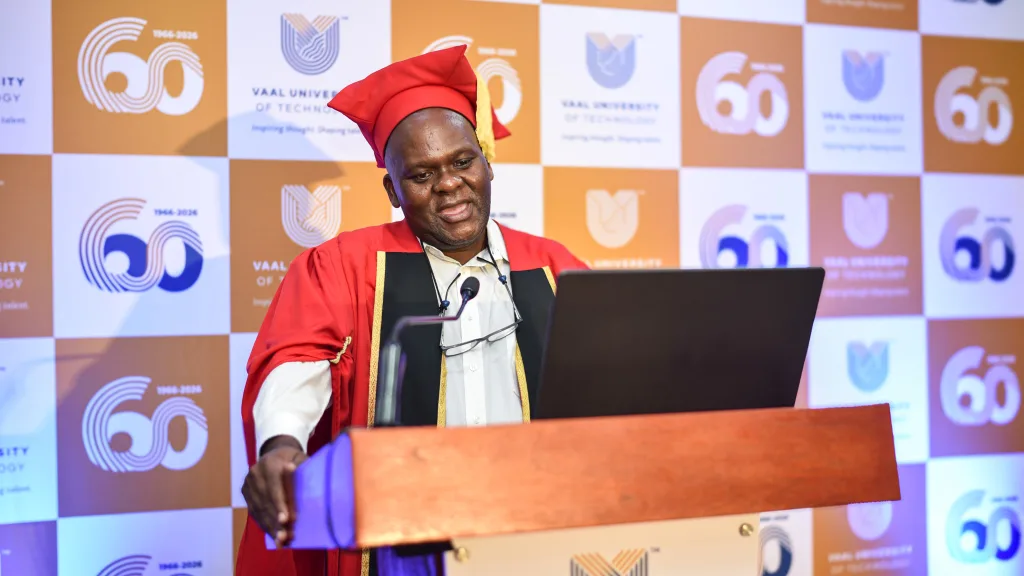
On 31 March 2026, the Vaal University of Technology (VUT) hosted an inaugural address by Professor Tranos Zuva at the Desmond Tutu Great Hall. The University convened the event to honour Prof Zuva for his distinguished academic milestone and to recognise his enduring contribution to scholarship, innovation, and intellectual leadership, which continues to strengthen the VUT academic community and extend its impact beyond institutional boundaries.
“Inaugural lectures are not ceremonial moments, they are intellectual milestones that allow us to reflect, engage, and advance inclusive knowledge systems within higher education,” said Mr George Mvalo, Director of Social Justice and Transformation at VUT, as he guided the programme with a strong academic and transformational focus.
Dr Nolutho Mkhumbeni, Executive Dean of the Faculty of Applied and Computer Sciences (FACS), set a reflective tone in her welcoming address, describing Prof Zuva as “a scholar whose work continues to shape the contours of computer science education and research across Africa and beyond.”
She presented a detailed academic profile that underscored both depth and distinction. Professor Zuva serves as a Full Professor of Computer Science and Faculty Research Professor within FACS at VUT. His leadership extends into national research ecosystems, where he holds the MICT SETA Fourth Industrial Revolution Research Chair and serves as Gauteng Node Branch Chair of the National Institute for Theoretical and Computational Sciences.
His academic journey reflects both breadth and global reach. He holds a Doctorate in Computer Science and Data Processing and an MBA from Tshwane University of Technology (TUT), a Master of Science in Computer Science from the National University of Science and Technology in Zimbabwe, a Master of Education in Mathematics from the University of Jose Varona in Cuba, and a Bachelor of Science Honours in Mathematics from the University of Zimbabwe.
With more than three decades of experience in teaching, research, and academic leadership, his contribution to computer science education spans across Africa and the international academic landscape. His research footprint is equally significant, with over 3,000 published works and more than 200 citations, reflecting sustained engagement in global knowledge production.
His research interests include mobile computing, computer vision, recommender systems, data mining, and information systems. Beyond publication, his influence is carried through the many master’s and doctoral students he has supervised, strengthening research capacity and advancing scholarship within the context of the Fourth Industrial Revolution (4IR).
At the centre of the occasion stood Prof Zuva himself, who framed the moment with both humility and purpose. “This moment is not only about looking back at what has been achieved but about recognising the responsibility we carry to shape the future through knowledge, capacity, and impact,” he said.
His lecture unfolded across three pillars, knowledge, capacity, and impact, each anchored in the realities of 4IR. Knowledge, he noted, demands rigour and discipline. Capacity requires the cultivation of graduates who are both skilled and responsive. Impact, he emphasised, must extend beyond academia into society and industry.
On Artificial Intelligence (AI), his tone shifted from reflection to challenge. “We must make AI our advantage, not our dependency,” he urged, cautioning that ethical engagement will define those who lead in an evolving academic and professional landscape.
The lecture also introduced the “Zuva Framework,” centred on ethical AI in education and research. “AI does not think, it processes. It does not understand, it predicts,” Prof Zuva remarked, reinforcing the enduring role of human judgement in academic work.
Reflecting on their shared academic history, Professor Topside Mathonsi of TUT noted that Prof Zuva’s influence extended far beyond institutional boundaries. His impact, he observed, “continued long after he left, through the students he mentored and the systems he helped build.” He further emphasised that research must remain purposeful, adding that it should respond directly to societal needs rather than exist for publication alone.
“Today is not only about celebrating a scholar, but also about affirming the kind of academic culture we are building,” said Professor Simphiwe Nelana, VUT Deputy Vice-Chancellor for Research, Innovation, Commercialisation and Internationalisation (RICI).
He pointed to the value of mentorship, noting that the true measure of academic work lies in the relevance and contribution of those it shapes.
Closing the programme, Mr David Farirai, Executive Director for Strategy at VUT, reflected on the broader institutional significance of the milestone. “This moment reflects the intersection of individual excellence and institutional vision,” he said, reaffirming the University’s commitment to innovation, academic excellence, and societal transformation.
Prof Zuva left the audience with a final reflection that lingered beyond the formalities of the occasion: “In the age of Artificial Intelligence, our greatest responsibility is not to compete with machines, but to deepen what makes us human, our ability to think critically, act ethically, and use knowledge in service of society.”