
“VUT hosted a public lecture on inclusive sport, where Prof Müller and Prof Mafini shared leadership lessons from the Springboks’ transformation.”
24 March 2026 | Story by: Qhawekazi | Picture: Supplied
4 minutes read time.
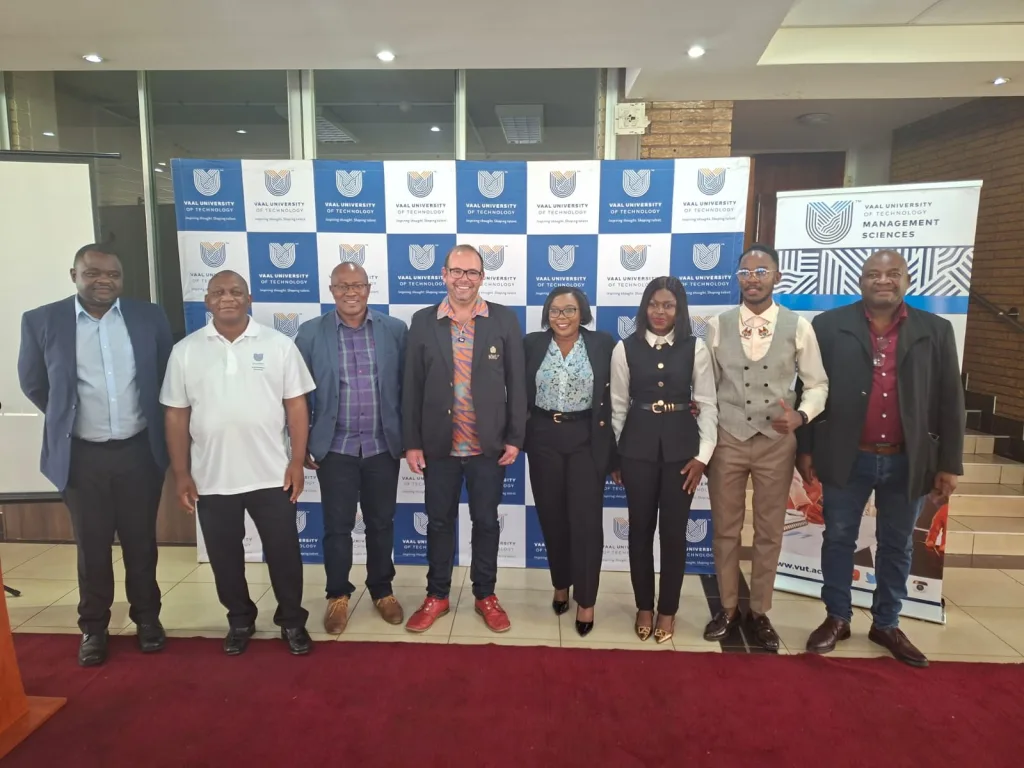
On 19 March 2026, at the Desmond Tutu Great Hall, the Vaal University of Technology (VUT) hosted a public lecture as part of its Road to 60 commemorative programme. The event examined how inclusive sport can serve as a powerful driver of social cohesion, institutional transformation, and national unity.
Organised by the Department of Marketing, Retail Business, and Sport Management, the lecture convened academics, students, and practitioners under the theme, Inclusive sport as a catalyst for social change.
The Springboks’ transformation as a leadership case study
The keynote address was delivered by Prof Re-an Müller, Deputy Director of the School of Management Sciences at North-West University. He unpacked the leadership philosophy that underpinned South Africa’s rugby resurgence and explored its broader relevance for organisations and higher education institutions.
Reflecting on the Springboks’ position in 2018, when the team was ranked seventh in the world and recovering from a difficult period, Prof Müller noted that the challenge extended beyond performance.
“The team faced a deeper crisis,” he said. “There was a lack of shared identity, purpose, and belonging.”
The appointment of Siya Kolisi as the first black African Springbok captain marked a turning point.
“It was not merely symbolic,” Prof Müller explained. “It represented authentic inclusion, allowing millions of South Africans to see themselves reflected in the national team for the first time.”
This shift restored trust in the Springbok brand and illustrated the role of sport in nation building within a diverse and historically divided society.
The Erasmus Effect and sustainable leadership
Central to the team’s turnaround was what Prof Müller described as the Erasmus Effect, a leadership approach grounded in trust, experimentation, and shared responsibility.
Innovations such as the strategic use of the Bomb Squad bench and simulation technologies in training were not only tactical decisions, but also mechanisms for building confidence and psychological safety within the team.
“The ultimate test of culture is sustainability,” he noted. “Our success through leadership transitions shows that strong values and culture become larger than any single individual.”
Beyond elite sport: addressing structural inequalities
The post lecture discussion extended the conversation beyond elite sport to the structural realities shaping grassroots participation. Attendees raised concerns about the cost of sport, unequal access to facilities, and socio-economic barriers that continue to limit opportunities for young athletes.
Prof Muller emphasised that inclusion must be systemic rather than symbolic.
“Inclusive sport must extend beyond representation at the professional level,” he said. “It requires sustained investment in development pathways, infrastructure, and transparent governance.”
From the field to the classroom
A significant portion of the discussion focused on translating leadership lessons from sport into academic and organisational environments. Prof Müller introduced the concept of the pyramid of play, advocating for gamification and interactive engagement to foster trust, creativity, and open communication.
He encouraged leaders and educators to begin with simple, practical interventions.
“Structured play and collaborative challenges create psychologically safe spaces where authentic dialogue becomes possible,” he said.
Participants expressed interest in applying these approaches within both physical and virtual classrooms, particularly in response to evolving models of hybrid learning and student engagement.
A call to action for leadership
In his closing remarks, Professor Chengedzai Mafini, Executive Dean of the Faculty of Management Sciences at VUT, underscored the value of collaborative academic engagement between VUT and North-West University.
“South Africans can grow within our complex socio-economic environment and still achieve global excellence,” he said.
He challenged leaders to actively embed these principles within their own teams, signalling his intention to incorporate elements of the Erasmus Effect into his leadership approach.
“Culture is never dependent on a single person,” Prof Mafini added. “If you take care of your employees, they will take care of your business.”
A legacy shaped through dialogue
As part of VUT’s 60-year milestone, the lecture forms part of a broader institutional reflection on legacy, leadership, and impact. By convening conversations that connect sport, leadership, and social transformation, the University continues to position itself as a platform for meaningful dialogue on the issues shaping South Africa’s present and future.