
“VUT’s Logistics Students’ Conference connected students with industry experts to explore entrepreneurship, AI, transport safety and resilient supply chains.”
26 August 2026 | Story by: Qhawekazi Memani | Picture: Siphephelo Dlamini
5 minutes read time.
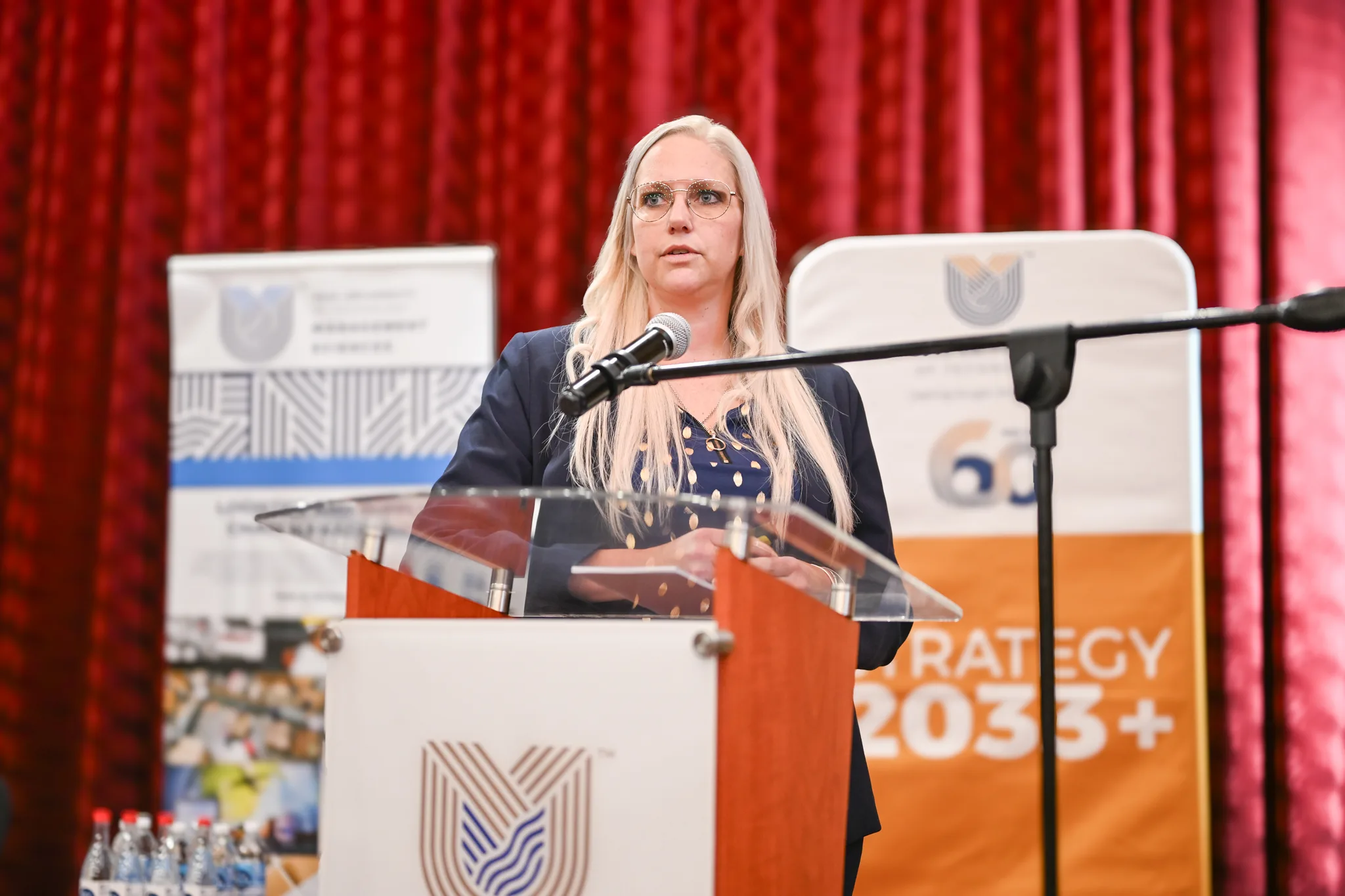
“Start. That’s all I can say. Start.”
This simple but powerful challenge from 23-year-old logistics entrepreneur Mr Jack Maluleke captured the spirit of the Logistics Students’ Conference hosted by the Department of Logistics and Supply Chain Management at the Vaal University of Technology (VUT) on 20 August 2026.
Held at the Desmond Tutu Great Hall on the VUT Main Campus, the conference brought students face to face with entrepreneurs, technology specialists and experienced industry professionals under the theme, “Building Resilient Supply Chains”.
More than an academic gathering, the conference gave students an honest view of an industry being reshaped by technology, uncertainty and growing pressure to move goods and services safely, efficiently and sustainably.
Mr Maluleke, Founder and Managing Director of Freightshift International Logistics, opened the programme by sharing how he entered the industry with no capital or established business infrastructure.
“What I did was to start. I started with no money. I started with 0 rands,” he told students.
He began by connecting customers who needed logistics services with companies that could provide them, using the income he generated to grow his business. His journey showed students that entrepreneurship can begin with something as simple as recognising a problem and finding a way to solve it.
He also spoke candidly about the unpredictable nature of logistics, where breakdowns, accidents and delays can quickly affect customers, cargo and business relationships. His advice was to respond decisively when problems arise instead of becoming paralysed by the potential cost.
The programme then shifted to technology and transport safety. Ms Elka Piesanie, Vice-President of Product Marketing at Powerfleet, demonstrated how digital platforms can
combine information from multiple vehicle-tracking systems to help businesses monitor driver behaviour, identify risks and make quicker operational decisions.
She explained that artificial intelligence (AI) is increasingly being used to process thousands of alerts and identify incidents requiring immediate attention. However, her presentation also reminded students that innovation must ultimately serve people.
Ms Piesanie highlighted the challenges faced by women in transport, particularly female truck drivers who continue to encounter safety risks and inadequate facilities. Her message placed inclusion and human dignity firmly within the broader conversation about building resilient transport systems.
Mr Charles Dey, a Training Consultant in International Supply Chain Management, drew on decades of experience in freight forwarding, logistics education and professional development. His career journey demonstrated that qualifications may open the door, but continuous learning, mentorship and adaptability are what sustain a career in a rapidly changing industry.
The conference was not all formal presentations. Student performances brought energy to the hall before Mr Vusi Mantsho challenged the audience to rethink the scale and influence of their chosen profession.
“Logistics is at the centre stage of service delivery,” he said.
He reminded students that logistics reaches far beyond trucks, warehouses and the movement of goods. It influences public services, infrastructure, sustainability and the flow of information across society.
Mr Mantsho encouraged students to see themselves as future entrepreneurs and problem-solvers rather than graduates waiting for someone else to create employment for them.
“The opportunities that are coming to us are not opportunities that are going to be created by somebody,” he said.
Connecting logistics with AI, recycling, the circular economy and climate-change adaptation, he urged students to use their time at University to build networks, acquire practical skills and identify gaps that could become viable business opportunities.
His message also became deeply personal.
“Don’t let your background disadvantage you. Don’t let issues of resources from your family disadvantage you. Don’t be scared to confront life.”
Professor Chengedzai Mafini, Executive Dean of the Faculty of Management Sciences, reinforced this call for confidence. He encouraged students not to underestimate
themselves, noting that achievement often begins with how people see their own potential.
“Don’t underestimate yourself. Sometimes the biggest limitation is not the resources you have, but the way you see yourself and your own potential,” he said.
Referring to sporting greats Cristiano Ronaldo, Lionel Messi and Tiger Woods, he highlighted the role of self-belief, discipline and determination in sustained success.
During the question-and-answer session, students engaged speakers on business funding, career opportunities and the realities of running a logistics operation. Mr Maluleke encouraged aspiring entrepreneurs to focus on solving genuine customer problems, while Mr Dey cautioned that start-ups often struggle to attract funding before establishing a credible track record.
The conference also celebrated student excellence, with awards presented to outstanding students and those who had made meaningful contributions to their peers and the Department.
Mr Thabang Sereo, President of the Enactus VUT team, introduced students to further entrepreneurship opportunities and shared his experience of developing a business that connects farmers directly with consumers.
Across the presentations, performances and conversations, one message remained clear: resilient supply chains depend on more than systems and technology. They depend on people who can adapt, think creatively and act when circumstances change.
For VUT’s logistics students, the conference offered more than a glimpse into the industry. It challenged them to recognise that they already have a place in its future.
As supply chains become more digital, interconnected and vulnerable to disruption, tomorrow’s logistics professionals will need technical knowledge, courage and an entrepreneurial eye for opportunity.
The students were therefore not simply asked to prepare for the future of logistics. They were challenged to help build it.