
“VUT food service management students gained practical wine-tasting, food-pairing and beverage service skills during the Wines of the World programme held from 28 to 29 August 2026.”
04 September 2026 | Story by: Sadiki Siphiwe | Picture: Sifiso Nomzaza
5 minutes read time.
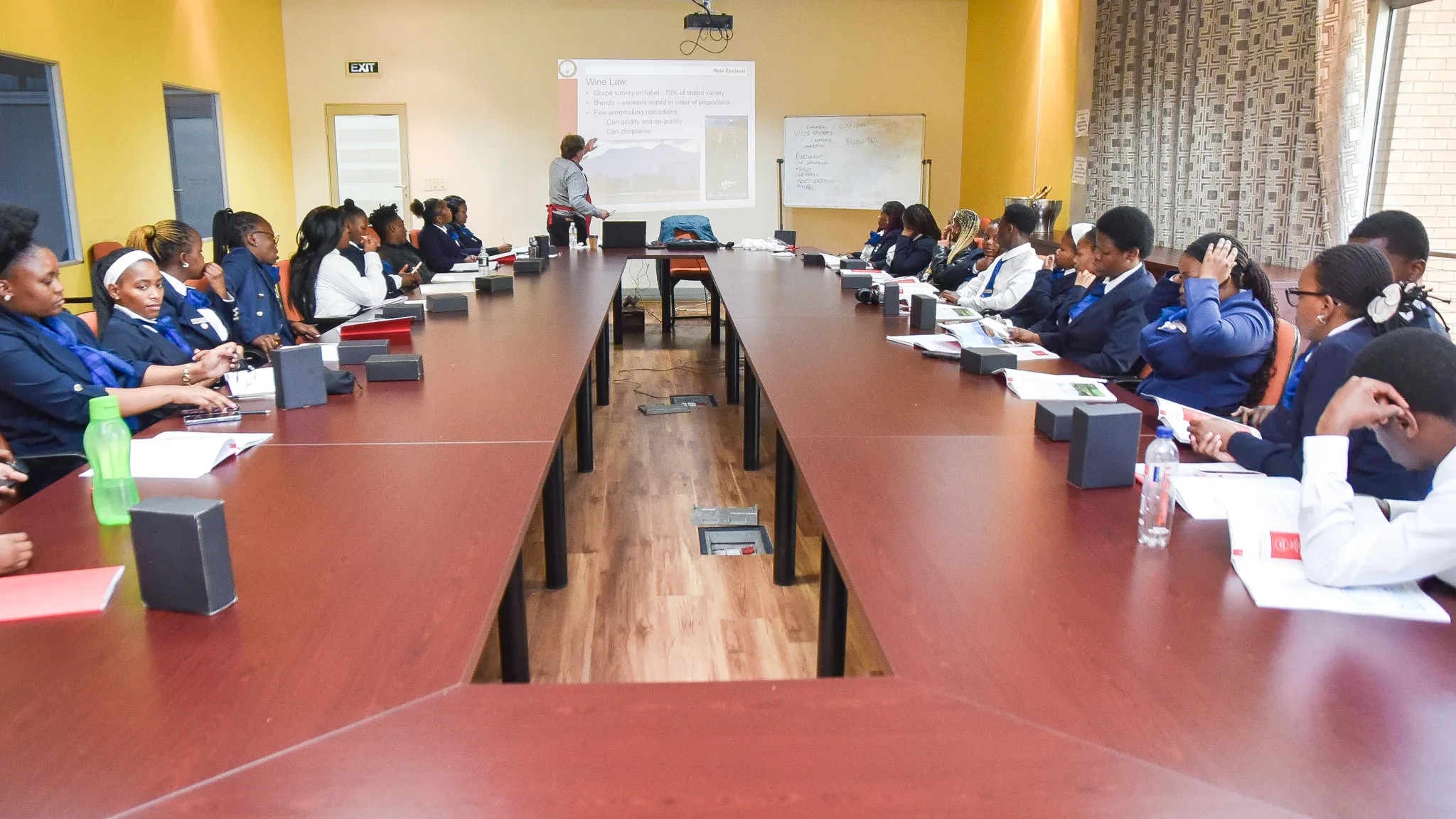
Second-year Food Service Management students at the Vaal University of Technology (VUT) gained valuable practical knowledge of international wines during a two-day Wines of the World educational programme held from 28 to 29 August 2026 in the IT Boardroom on the VUT campus.
The programme was designed to expose students studying Food and Beverage Operations to the fundamentals of wine tasting, wine service, grape varieties, wine-producing regions and the art of pairing wine with food. The practical sessions enabled students to move beyond theoretical classroom learning and gain firsthand experience in identifying and comparing wines from different parts of the world.
The programme was facilitated by wine specialist Mr Leonard De Klerk, a Wine Master from the Cape Wine Academy. Drawing on his expertise in wine education, Mr De Klerk guided students through the characteristics of wines from renowned wine-producing regions, including France, South Africa, Chile, Australia and New Zealand.
Mr De Klerk encouraged students to approach the programme as a professional learning opportunity rather than simply a wine-tasting experience.
“You are here to learn, not just to drink what you want. When you are learning about wine, you have to be open-minded, experience different styles and understand why wines taste different,” said Mr De Klerk.
One of the highlights of the programme was a comparative tasting of French Pinot Noir from Burgundy and South African Pinot Noir. Students examined the colour, aroma, acidity, tannins and fruit characteristics of both wines while learning about the distinctions between Old World and New World wine styles.
Mr De Klerk explained that Pinot Noir is among the most challenging grape varieties to cultivate and is strongly associated with cooler wine-producing regions.
“Pinot Noir is often called the heartbreak grape because it is a difficult grape to grow. Understanding that difficulty helps you appreciate why wines made from it can differ greatly in style, quality and price,” he explained.
Students were also introduced to Merlot from Chile, where discussions focused on how climate and geographical conditions influence a wine’s character. A tasting session followed, allowing students to apply their knowledge through sensory evaluation.
“When you taste a wine, you should not only ask whether you like it. You should ask where it comes from, what conditions it was grown in and what type of food it can complement,” Mr De Klerk told the students.
The programme further explored New Zealand Chardonnay, with particular attention given to the South Island’s cooler climate. Students identified characteristics such as acidity, freshness and green-fruit flavours while exploring the important relationship between wine and food. Discussions highlighted the suitability of New Zealand wines for seafood dishes such as mussels and calamari.
Food pairing formed a key component of the practical sessions. Students learned how different wines complement different foods, with Pinot Noir, for example, pairing well with lighter dishes such as roast lamb, roast chicken and selected pork dishes.
“Wine service is not simply about pouring a glass. In the hospitality industry, you need to understand the wine well enough to recommend it appropriately and explain why it works with a particular meal,” said Mr De Klerk.
The students also received practical training on the safe opening and service of sparkling wine. Mr De Klerk demonstrated how to handle bottles under pressure and emphasised the importance of safety and proper technique.
“When opening sparkling wine, safety must always come first. Never point the bottle towards another person. Control the cork and release the pressure slowly and carefully,” he advised.
Supporting the programme was Ms Julia Mofokeng, Lecturer in Food Service Management at VUT, who plays an important role in guiding second-year students in their academic and professional development. She highlighted the value of practical industry exposure in preparing students for careers in the hospitality sector.
“As lecturers, we want our students to leave the classroom with knowledge that they can apply in the workplace. This programme allows them to experience wine service practically and understand its importance within food and beverage operations,” said Ms Mofokeng.
For the students, the programme provided an opportunity to build confidence and deepen their understanding of wine appreciation. Ms Kumnandi Mbede said the experience challenged her perceptions and broadened her knowledge of the industry.
“I came here thinking that wine tasting was mainly about drinking and deciding whether you like a wine. I have learned that there is much more to it. We now understand how the grape variety, climate, region and food pairing can influence the wine we taste,” said Mbede.
She added that the programme’s practical nature made the learning experience particularly meaningful.
“The experience has given me knowledge that I can use in the hospitality industry. I now feel more confident about identifying different wines, understanding their characteristics and explaining why a particular wine can be paired with certain food,” she said.
The programme also reinforced the importance of responsible wine tasting. Students were reminded that professional wine tasting focuses on observation, evaluation and learning rather than excessive consumption.
In closing, Mr De Klerk encouraged students to remain curious and continue building their professional knowledge.
“You did not come here simply to taste what you already like. You came to learn. Sometimes you will taste something you do not enjoy, but that experience is still valuable because it gives you knowledge,” he said.
The two-day Wines of the World programme demonstrated VUT’s commitment to providing students with industry-relevant, experiential learning opportunities. Through direct engagement with a wine specialist and practical exposure to international wine regions, food pairing and professional beverage service, VUT’s second-year Food Service Management students gained valuable skills and insights that will support their future careers in restaurants, hotels, catering establishments and the broader hospitality industry.