
“Prof Nyna Amin urged universities to move beyond rankings and become civic anchors driving innovation, inclusion and social impact at the VUT conference.”
09 September 2026 | Story by: Sadiki Siphiwe | Picture: Keitumetse Mokgope
6 minutes read time.
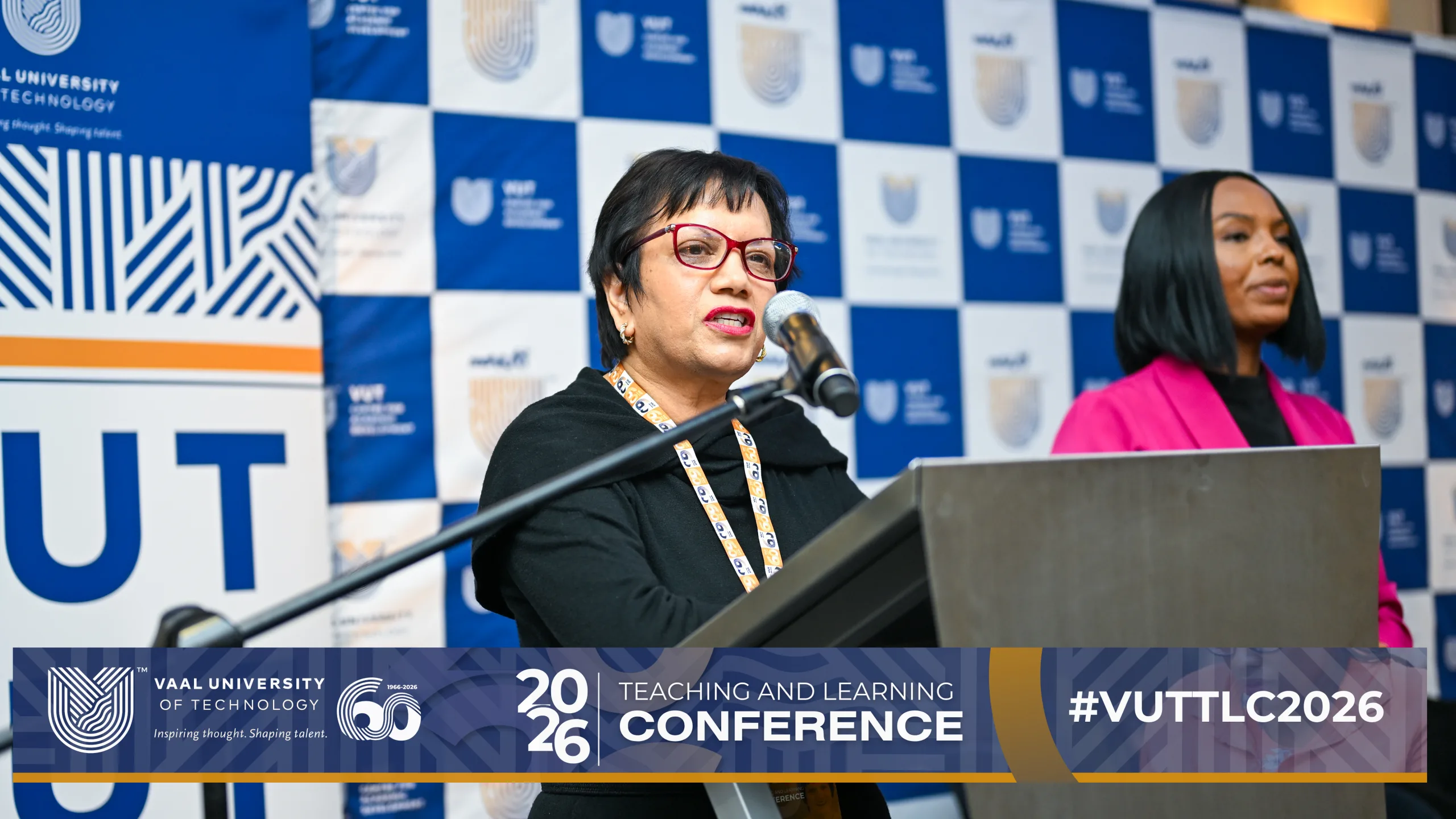
Universities must move beyond chasing global rankings and become active partners in solving the social and economic challenges of their communities. This was the central message delivered by Prof Nyna Amin, Interim Director of Teaching and Learning at the University of KwaZulu-Natal (UKZN), during a keynote address at the Vaal University of Technology’s (VUT) Teaching and Learning Conference underway at Emerald Resort in Vanderbijlpark from 8 to 10 September 2026.
Addressing academics, researchers and higher education practitioners under the conference theme, “Reimagining Teaching and Learning for the Future: Innovation, Inclusion and Impact in Higher Education,” Prof Amin challenged delegates to rethink the role of universities in a rapidly changing world.
In an unconventional presentation delivered without PowerPoint slides, Prof Amin encouraged participants to imagine new possibilities for higher education free from traditional constraints.
She began by reflecting on the significance of the Vaal region, noting that Vanderbijlpark was established as an industrial city built around steel production, while the nearby Vaal River has remained a symbol of adaptability and resilience.
“The river refuses straight lines. It changes course, adapts and sustains life around it,” she said. “Higher education today faces a similar challenge. Institutions built for a previous era must learn how to adapt to constant change while remaining relevant to society.”
Prof Amin also referenced the historical significance of the Vaal Triangle, including Sharpeville and the 1984 uprisings, arguing that innovation and transformation in higher education cannot be separated from questions of justice, dignity and inclusion.
“Reimagining higher education is not simply a technical exercise,” she said. “It is a moral imperative.”
Linking her message to the conference theme and VUT Strategy 2033+, Prof Amin outlined a vision for universities built around three interconnected concepts: the liquid campus, the wise machine, and the civic anchor.
The first concept, the liquid campus, calls for more flexible learning pathways that recognise diverse forms of knowledge and learning experiences. According to Prof Amin, traditional university structures were designed for a time when relatively few people accessed higher education and graduates could expect secure employment after completing a degree.
Today’s reality, however, is very different. Student participation continues to grow globally while labour markets are changing rapidly, requiring graduates to update and expand their skills throughout their careers.
She argued that universities should move towards lifelong learning models that include micro-credentials, recognition of prior learning, short courses and workplace-based learning opportunities.
For South Africa, such flexibility can create opportunities for people who may not have followed traditional educational pathways but still need access to further education and skills development.
“The university can no longer be a place people enter once and leave forever,” she said. “Learning must be continuous, flexible and accessible.”
Her second concept, the wise machine, focused on the growing influence of artificial intelligence in higher education.
While acknowledging the transformative potential of AI technologies, Prof Amin cautioned against viewing artificial intelligence as a replacement for human judgment.
She argued that while machines can process information at unprecedented speed, they cannot replicate wisdom, ethics, compassion or critical judgment.
“Intelligence is not wisdom,” she said. “Wisdom is knowing which questions matter, whose voices are missing, and how decisions affect people.”
As AI becomes increasingly embedded in teaching and learning environments, universities should focus on developing graduates who can evaluate information critically, navigate complex challenges and exercise ethical leadership.
Prof Amin suggested that academics must rethink their teaching approaches, moving away from content delivery and towards facilitating deeper learning, problem-solving and critical engagement.
“The future value of higher education will not be based on who can provide information fastest,” she said. “It will be based on who can develop critical thinkers capable of making wise decisions in an uncertain world.”
Her third and most significant proposition was the idea of the civic anchor university.
Drawing on international scholarship, Prof Amin argued that universities should be judged not primarily by international rankings, but by the extent to which they improve the lives of the communities they serve.
She criticised what she described as a long-standing tendency among universities to define excellence through comparison with elite global institutions.
“Excellence cannot simply mean looking like Harvard, Oxford or Cambridge,” she said. “Universities are excellent when they help reduce exclusion, create opportunities and contribute meaningfully to society.”
A civic anchor university, she explained, takes responsibility for addressing challenges within its immediate environment, including unemployment, social inequality, environmental sustainability and economic development.
For VUT, she said, this approach aligns closely with Strategy 2033+, which emphasises innovation, impactful research, digital transformation and societal contribution.
She further called for greater recognition of community knowledge, indigenous knowledge systems and practitioner expertise, arguing that universities must embrace a broader understanding of knowledge creation.
“The civic university treats community voices as partners, not simply as recipients of expertise,” she said.
Prof Amin concluded by warning delegates against allowing transformative ideas to become diluted through bureaucracy and compliance processes.
She noted that concepts such as innovation, inclusion and decolonisation often lose their transformative power when reduced to policies, checklists and performance indicators.
Real change, she argued, is achieved through countless small actions undertaken by committed individuals across institutions.
“Transformation does not arrive all at once,” she said. “It emerges through everyday decisions, through the questions we ask, the curricula we design and the opportunities we create for our students.”
Encouraging delegates to draw inspiration from the Vaal River, she urged them to embrace adaptability, courage and imagination in shaping the future of higher education.
“The river was here before the city of steel, and it will remain long after,” she said. “It teaches us that true endurance belongs to those who can adapt, find new pathways and continue moving forward. Universities must learn to do the same.”
As the conference continues, Prof Amin’s keynote has provided a powerful call for institutions to rethink their purpose and strengthen their role as drivers of innovation, inclusion and social impact in a rapidly changing world.