
“Dr Julie Lindsay challenged educators to rethink AI in education, exploring human-AI collaboration, global learning and human agency at the VUT Teaching and Learning Conference 2026.”
09 September 2026 | Story by: Qhawekazi Memani | Picture: Siphephelo Dlamini
5 minutes read time.
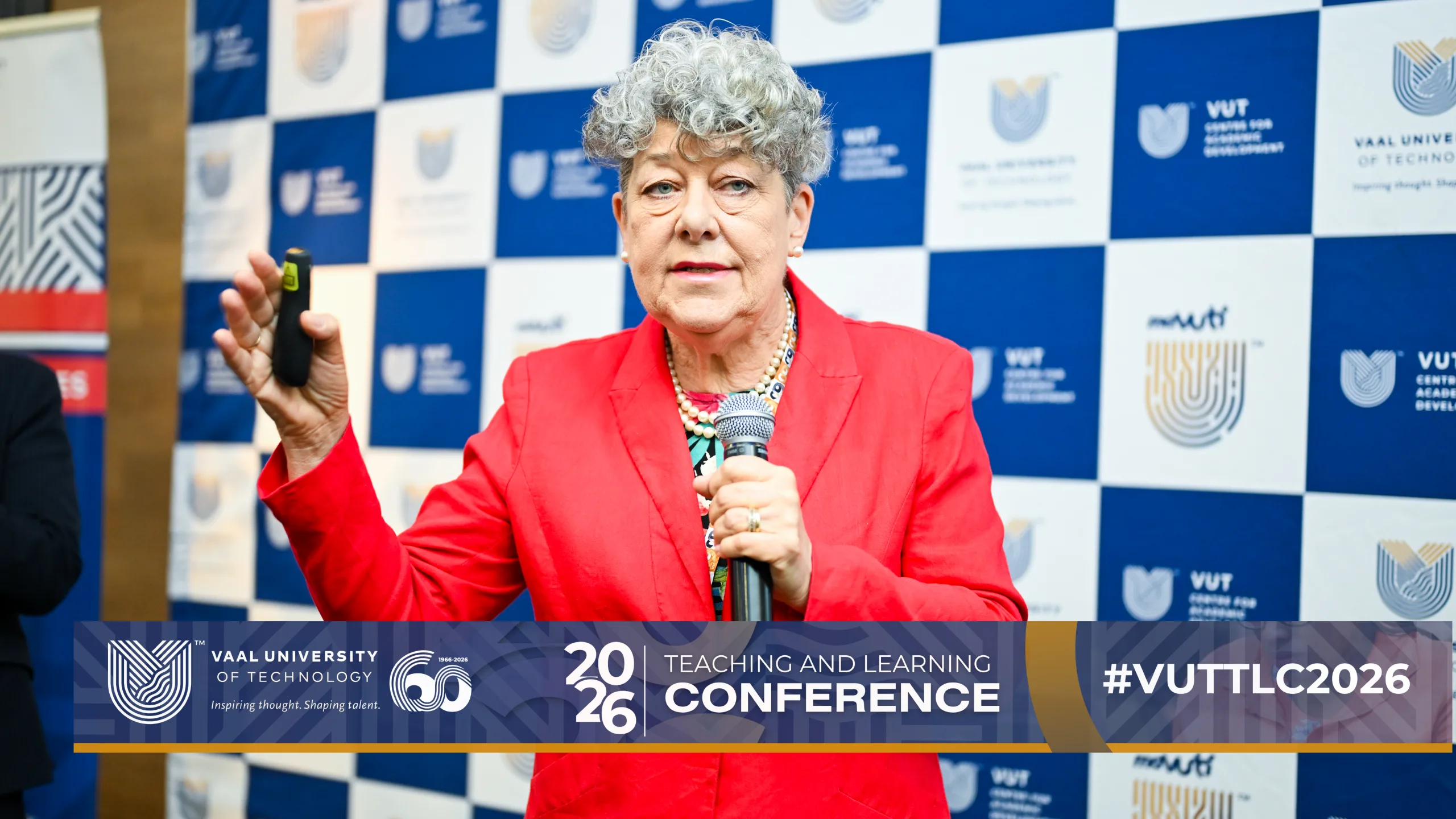
The future of education is not about choosing between humans and artificial intelligence, but about learning how the two can work together. This was the central message from international education specialist Dr Julie Lindsay, who delivered a thought-provoking keynote address at the Vaal University of Technology’s (VUT) Teaching and Learning Conference 2026.
Drawing on more than three decades of experience in education and global collaborative learning, Dr Lindsay challenged educators to move beyond viewing AI merely as a technological tool and consider its role in supporting collaboration, creativity and knowledge creation.
Her keynote presentation, A person is a person through others – including AI, invited delegates to rethink the relationship between technology and learning, arguing that the most important question is not what AI can do, but how it shapes the ways people learn, connect and create knowledge together.
“The most important question about artificial intelligence in education is not ‘What can I do?'”
Building on this idea, Dr Lindsay encouraged educators to reconsider how intelligence itself is understood. Rather than existing solely within an individual or a machine, intelligence can emerge through collaboration, relationships and shared experiences.
This perspective offers an opportunity to think differently about AI in education. Instead of viewing artificial intelligence simply as a service provider or information source, educators can position it as part of a broader learning ecosystem that supports inquiry, problem-solving and knowledge creation.
“The missing link,” Dr Lindsay explained, is considering “AI as a relation” and deliberately recognising it as a “relational participant within a learning ecosystem.”
At the same time, she stressed that human agency must remain at the heart of teaching and learning.
“We want to maintain creative ownership and intentional decision-making.”
Her message comes at a time when universities around the world are navigating complex questions around AI-generated content, academic integrity, assessment practices and the future role of educators in increasingly digital learning environments.
Dr Lindsay’s approach is closely connected to her longstanding work in global collaborative learning. Long before generative AI became part of mainstream educational conversations, she was using technology to connect learners across classrooms, institutions and countries, enabling them to share perspectives and work together on meaningful projects.
These experiences shaped a philosophy that remains highly relevant today.
“We need to learn the world, not just about it.”
For Dr Lindsay, global learning extends far beyond connecting students online. It involves engaging with diverse cultures, viewpoints and lived experiences to better understand an increasingly interconnected world. As AI becomes embedded in education, she argued that educators must also consider the social and cultural dimensions of technology and how students interact with AI alongside people from different backgrounds.
She challenged delegates to reflect on whether students are using AI as passive consumers of information or as active participants in knowledge creation.
If AI is used simply to generate answers or complete tasks, students risk becoming dependent on machine-produced content. However, when used intentionally, AI can become part of a collaborative process in which students question, evaluate, refine and build upon ideas.
“AI becomes a creative collaboration.”
This distinction is critical because the goal is not merely to teach students how to use AI tools. Rather, students must develop the ability to work alongside AI while retaining critical judgement, creativity and ownership of their learning.
The growing role of AI also raises important questions about assessment. Traditional approaches often focus on the final product submitted by a student. However, when AI contributes to the learning process, the final output may reveal little about how learning actually occurred.
For this reason, Dr Lindsay highlighted the value of process-based assessment. By examining how students engage with AI, make decisions, collaborate, reflect and create knowledge, educators can gain a richer understanding of learning.
The conversation therefore shifts from asking whether AI was used to exploring how it was used, why it was used and how students evaluated its contributions.
Rather than making learning invisible, AI can provide new ways of making learning processes more visible and meaningful.
Dr Lindsay also linked these ideas to shared regulation of learning. As students collaborate with one another and with AI, they must negotiate roles, responsibilities and expectations. Success in AI-enabled environments therefore relies on more than technical competence.
It also requires distinctly human qualities such as curiosity, critical thinking, communication, empathy, reflection and responsibility.
For educators, this means moving beyond simply introducing AI tools in the classroom. It requires intentionally designing learning environments where relationships between students, educators, technology and the wider world contribute to meaningful learning experiences.
Ultimately, Dr Lindsay’s keynote was an invitation to reimagine teaching and learning in ways that place relationships, collaboration and human agency at the centre.
For delegates attending the VUT Teaching and Learning Conference 2026, her presentation offered a timely perspective on one of the most significant issues facing higher education today. The challenge is no longer whether AI belongs in education, but how it can be integrated responsibly to support learning, creativity and innovation while empowering students to take ownership of their educational journeys.
Returning to the central theme of her presentation, Dr Lindsay reminded delegates that technology should strengthen rather than diminish the human dimension of education.
In this sense, the future of AI in education is not about replacing people with machines. It is about creating richer connections between people, technology, knowledge and the world.
And, ultimately, it comes back to a simple but powerful idea: “A person is a person through others – including AI.”