
“Njo Makapela-Cikizwa has called for a more inclusive, flexible and human-centred approach to higher education, with responsible AI supporting rather than replacing student thinking.”
09 September 2026 | Story by: Qhawekazi Memani| Picture: Keitumetse Mokgope
5 minutes read time.
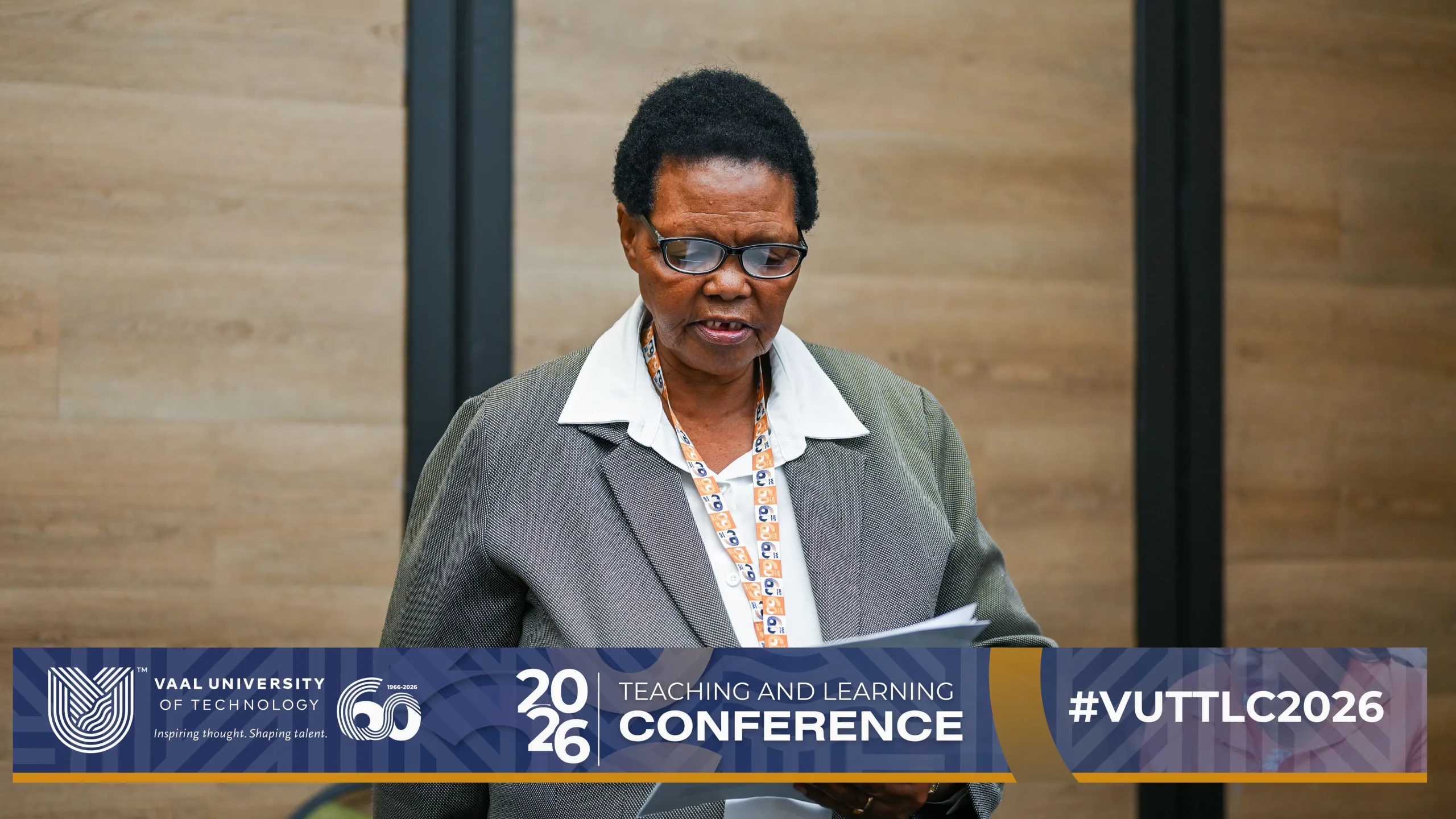
Higher education institutions need to rethink how they define student success and prepare learners for a rapidly changing future, according to Ms Njo Makapela-Cikizwa, Senior Lecturer in the Tourism and Integrated Communication Department at the Vaal University of Technology (VUT).
Presenting her paper, “Reimagining Teaching and Learning for the Future: Innovation, Inclusion and Impact on Higher Education”, on 8 September 2026 at the VUT Teaching and Learning Conference, Makapela-Cikizwa argued that universities are at a critical crossroads, shaped by rapid technological change, increasing student diversity, economic pressures and evolving workplace expectations.
The presentation formed part of the conference subtheme, “Advancing Student Success and Holistic Development”.
Makapela-Cikizwa said traditional measures such as grades, pass rates and graduation figures provide only a limited picture of whether students are genuinely succeeding. A future-focused approach, she said, should combine academic achievement with psychological wellbeing, a sense of belonging, cultural validation and the development of ethical, socially responsible graduates.
The study employed a mixed-methods approach, drawing on a quantitative survey of 4 500 students across eight higher education institutions, 45 semi-structured interviews with academic leaders and 12 student focus groups. Data was collected between September 2025 and June 2026.
Its findings highlighted the importance of combining technological innovation with high-touch human support.
According to Makapela-Cikizwa, technology should strengthen human connection rather than replace it. Learning environments should become more dynamic, experiential and multimodal, giving students greater flexibility in how they access content and demonstrate learning.
The presentation also highlighted the growing value of micro-credentials, stackable certificates and flexible, self-paced learning pathways that can complement traditional curricula.
A key focus of the presentation was the expanding role of artificial intelligence (AI) in higher education. Makapela-Cikizwa acknowledged that tools such as ChatGPT can assist students with brainstorming, explaining complex concepts, improving language and writing skills, generating practice questions, providing feedback and supporting research planning.
However, she drew a clear distinction between using AI as a learning aid and allowing it to replace a student’s intellectual effort.
Students, she argued, should not submit AI-generated work as their own, use AI to complete entire assignments without disclosure, employ AI in assessments where it is prohibited, or rely on unverified AI-generated references and information. They should also be able to explain and defend the work they submit.
“We should not draw the line between humans and AI. We should draw the line between assistance and substitution,” said Makapela-Cikizwa.
The principle of keeping “the human in the loop” was presented as central to responsible AI use. While AI can support learning, students must remain the primary thinkers, decision-makers and accountable authors of their work.
Assessment practices, she suggested, may need to place greater emphasis on the learning process rather than solely on the final product. Possible approaches include oral presentations and defences, practical demonstrations, reflective journals, portfolios, draft submissions and personalised assessments. Students could also be encouraged to critique and improve AI-generated responses.
Makapela-Cikizwa posed a question that challenges institutions to reconsider how academic achievement is assessed:
“If a student submits excellent work but cannot explain how they arrived at it, whose knowledge are we actually assessing?”
Her presentation also called on higher education institutions to move beyond symbolic diversity statements and compliance-driven approaches towards creating genuine structural belonging.
Universal Design for Learning was identified as a practical framework for improving accessibility by offering content in multiple formats, including captioned videos, transcripts and interactive learning activities.
Makapela-Cikizwa further advocated for curricula that recognise diverse voices, histories and ways of knowing, alongside practical interventions that address financial and logistical barriers faced by students.
Open educational resources, digital equity initiatives, access to devices and reliable internet connectivity, childcare support and other student-centred interventions were highlighted as important elements of an inclusive learning environment.
The presentation also emphasised that student success cannot be separated from wellbeing. Challenges such as food insecurity, housing instability and mental health concerns can significantly affect academic engagement and performance.
Rather than treating these issues as separate from teaching and learning, institutions were encouraged to integrate student affairs, wellness services and academic advising through coordinated support systems, proactive outreach, peer support initiatives and counselling services.
Two institutional examples demonstrated how these principles can be put into practice.
At a large metropolitan research university, multimodal active learning was combined with a predictive student-care platform. When signs of disengagement emerged, mentors and mental health advisers intervened. Over a two-year period, the approach was associated with a 22% increase in course completion rates, particularly among first-generation and low-income students.
At a regional technical institute, open educational resources, flexible academic calendars, block-course delivery and evening, weekend and asynchronous learning options were paired with stackable credentials and centralised student support services. These included a food pantry, financial aid assistance and emergency childcare vouchers. The institution reported an 18% increase in year-to-year student retention.
Makapela-Cikizwa argued that institutions should measure success beyond retention and graduation rates by also considering graduate employability, civic participation, student satisfaction and progress in closing equity gaps.
She concluded with a call for higher education institutions to move away from rigid, transactional models and towards dynamic, empathetic and holistic learning ecosystems.
The ultimate goal, she said, should be to ensure that innovation expands access, strengthens human relationships and removes barriers to participation.
In this vision, universities are not merely gatekeepers of knowledge but vibrant, open communities where technology, inclusion and human connection work together to support students’ academic achievement and personal development.