
“The VUT SRC Academic Seminar 2026 equipped first and second-year students with guidance on academic success, support, leadership and progression.”
20 August 2026 | Story by: Sadiki Siphiwe | Picture: Sifiso Nomzaza
5 minutes read time.
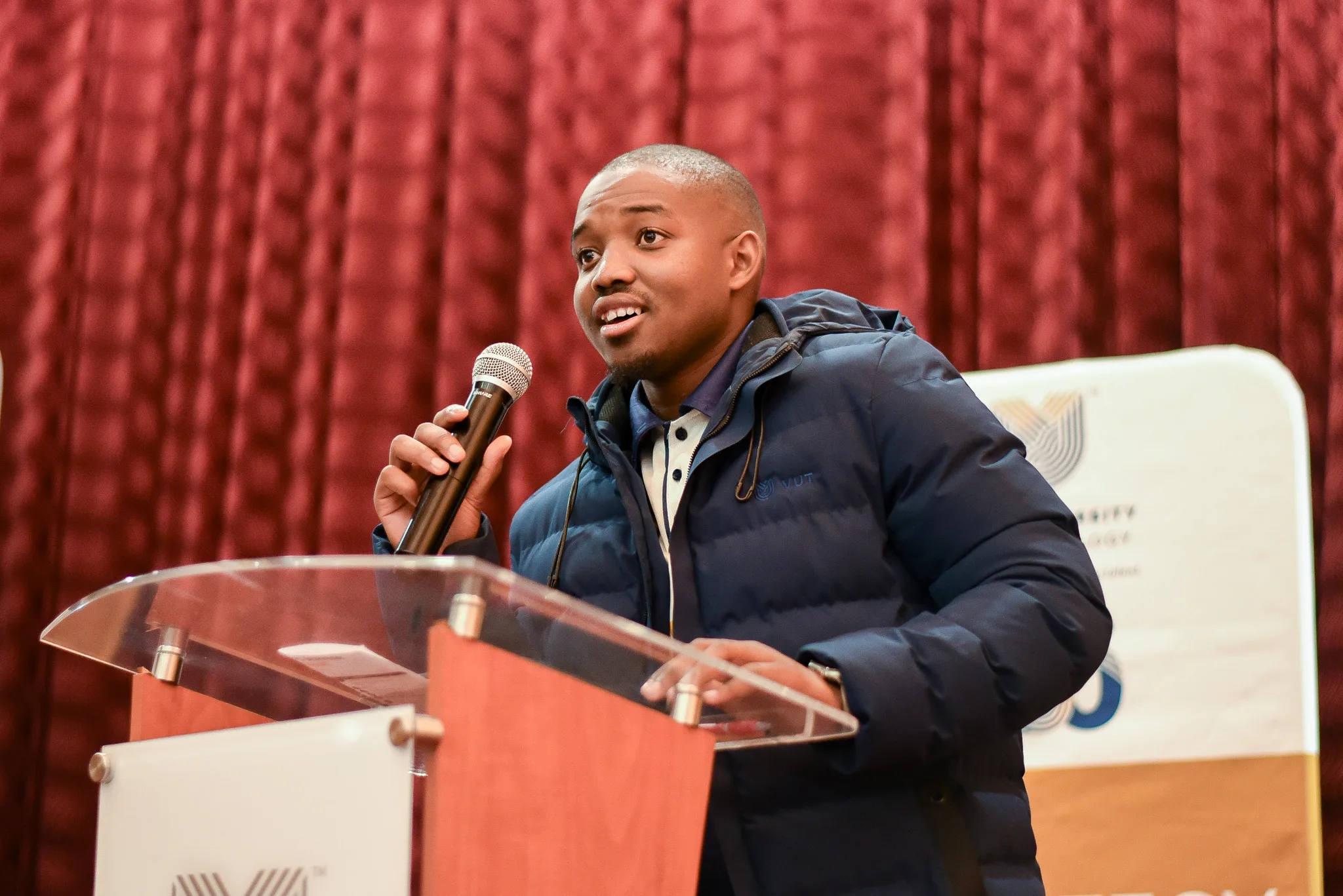
For many first and second-year students, navigating university life can be as challenging as the academic work itself. Understanding progression rules, knowing where to seek support and making informed choices can determine whether a student merely survives university or begins to thrive.
It was against this backdrop that the Vaal University of Technology (VUT) Student Representative Council (SRC) brought students together for a two-day Academic Seminar at the Desmond Tutu Great Hall on 13 and 14 August 2026. Led by SRC Academic Officer, Mr Carcidio Khoza, the seminar was designed to give students practical guidance on some of the academic and administrative issues they are most likely to encounter during the early years of their studies.
Rather than taking a one-size-fits-all approach, the programme was structured around the different faculties. Students from the Faculty of Management Sciences and Faculty of Human Sciences attended on the first day, while the second day focused on the Faculty of Engineering and Technology and the Faculty of Applied and Computer Sciences.
Opening the seminar, Mr Khoza encouraged students to take greater responsibility for their academic journeys and to make full use of the opportunities available to them.
“Study hard, remain committed to your academic journey, make the most of every opportunity, and take pride in being part of VUT, a home of excellence,” he said.
He also urged students to remain disciplined as the University moves further into the second semester and encouraged them to speak openly about academic challenges instead of struggling in isolation.
Dr Moses Matsheke, Head of the Department of Logistics and Supply Chain Management, delivered a message on behalf of Professor Chengedzai Mafini, Executive Dean of the Faculty of Management Sciences. His contribution brought a more personal dimension to the conversation, acknowledging that university life comes with both progress and setbacks.
“Every home has stories, meaning progress and challenges are part of any journey. VUT’s best strength is its people, and your success is valued by the institution,” he said.
Drawing on his own experience as a parent whose children have studied at VUT, Dr Matsheke encouraged students to seek help early and use the support structures available to them before challenges become overwhelming.
The seminar also placed student leadership under the spotlight. Mr Poki Mahooa, Acting Director: Student Support Services, speaking on behalf of Dr Gugulethu Xaba, Executive Director: Student Support Services (SSS), reminded students that their participation in university governance has a direct bearing on their academic environment.
“Choosing academically supportive leaders begins with student engagement, including voting and ensuring that the University’s representatives understand student needs,” he said.
With SRC elections expected in early September, Mr Mahooa encouraged students to participate actively and to think carefully about the kind of leadership they want representing them.
A significant part of the seminar focused on the academic rules that often cause confusion for students. Assistant Registrar Ms Malejone Moqhoba explained academic progression requirements and the reasons administrative blocks may occur when students attempt to change or add modules.
“Students cannot add modules such as 1.2 if they have not passed 1.1,” she explained.
Her session helped students understand that many registration challenges are linked to prerequisite requirements and that knowing these rules early can prevent unnecessary delays.
Ms Nonkululeko Xuza, Assistant Registrar in the Examinations and Graduation Office, unpacked the special examination process and the support available to students who may be prevented from graduating because of a single outstanding module.
“The special exam process is designed to assist students who may otherwise be blocked from graduating due to a single module,” she said.
She explained the eligibility requirements, faculty-level application processes and additional opportunities available to qualifying students, including examination opportunities in January.
Academic decision-making was another key focus. Mr Mothusi Samosamo, Learning Development Coordinator at the Centre for Academic Development (CAD), cautioned students against making changes to their programmes without understanding the possible consequences.
“Changing courses could have academic impacts and therefore should be approached carefully, and CAD is here to help you use artificial intelligence responsibly for writing and research,” he said.
He encouraged students to visit CAD in the PS Building for academic development workshops, writing support and guidance, stressing that students should seek informed advice rather than rely on assumptions when making important academic decisions.
For second-year Diploma in Marketing Management student Ms Sihle Angela Vilakazi, the value of the seminar lay in how closely the discussions reflected the realities students face.
“The seminar was very informative and relevant to us as first and second-year students. I appreciated that the discussions focused on issues that we are currently experiencing in our academic journey,” she said.
She added that the seminar had helped her better understand academic progression and the support available to students.
“It gave me more confidence and motivation to take my studies seriously, seek guidance when necessary, and make informed decisions as I continue with the academic year.”
Closing the seminar, Mr Khoza thanked the speakers and students for their participation and reminded attendees that the purpose of the programme was ultimately to help them succeed.
“This seminar exists to support your academic progress, and we are grateful for your commitment, presence and dedication to shaping VUT’s future,” he said.
More than simply sharing rules and procedures, the seminar created a space where students could better understand how the University works, where to turn when they encounter difficulties and what role they themselves must play in their academic success. As VUT marks 60 years of excellence, the message to students was clear: success begins with asking questions, seeking support and taking ownership of the journey.