
“Professor Peter Osifo’s inaugural address at VUT explored how biomass waste can advance renewable energy, water reuse and sustainable development.”
25 August 2026 | Story by: Tayron Mhlongo | Picture: Keitumetse Mokgope
4 minutes read time.
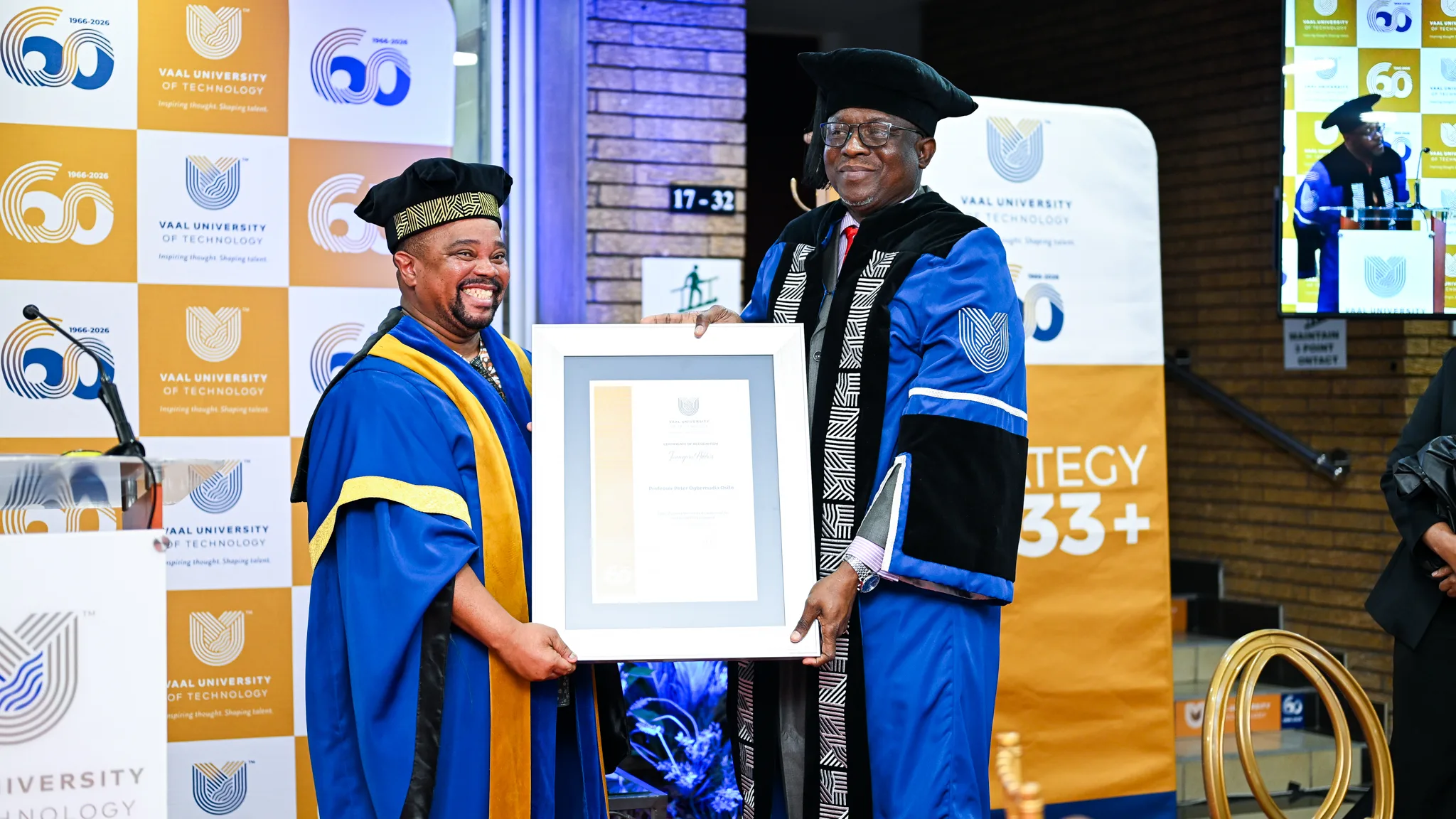
Professor Peter Ogbemudia Osifo used his inaugural address at the Vaal University of Technology (VUT) to challenge conventional thinking about waste, demonstrating how discarded materials can be transformed into renewable energy, advanced materials and resources for environmental remediation.
Delivered at the Desmond Tutu Foyer on 21 August 2026 under the title Biomass Wastes as a Continuum for Sustainable Development, the address marked an important academic milestone following his appointment as Full Professor of Chemical Engineering.
At the heart of his address was a simple but urgent proposition: waste should not be viewed only as an environmental burden, but as a resource capable of supporting sustainable development.
“As humanity confronts increasing environmental challenges, resource depletion, climate change and growing energy demands, the search for sustainable alternatives has become imperative,” Professor Osifo said.
His research concentrates on two significant but underutilised waste streams: fishery waste and sewage sludge. Through scientific processing and conversion, these materials can be used to develop valuable products that contribute to environmental remediation, renewable energy generation and advanced material development.
“My focus has been the transformation of these unique waste materials into valuable products for environmental remediation, renewable energy generation and advanced material development,” he explained.
This work speaks directly to some of the most pressing challenges facing South Africa and the continent, including waste management, water scarcity, energy insecurity and environmental degradation. It also advances the principles of the green and circular economy by promoting resource recovery, water reuse and sustainable waste conversion.
Professor Osifo’s inaugural address was underpinned by more than two decades of academic service, research and leadership at VUT. As a National Research Foundation (NRF) C2-rated researcher, he has secured more than R15 million in research funding from national and industry partners.
His scholarly record includes 48 peer-reviewed journal articles, two authored books and nine book chapters. Beyond these achievements, his contribution is also reflected in the next generation of researchers he has helped develop, having supervised 11 master’s and three doctoral students to graduation.
Responding to the address, Professor Bernard Tchomeni, Acting Research Professor in Industrial and Operations Management and Mechanical Engineering, reflected on the connection between Professor Osifo’s research, technological innovation and societal impact.
“One message particularly stands out: waste should not simply be regarded as a problem, but as a potential resource,” Professor Tchomeni said.
Professor Simphiwe Nelana, VUT Deputy Vice-Chancellor: Research, Innovation, Commercialisation and Internationalisation (DVC RICI), said Professor Osifo’s commitment to developing students was one of the defining features of his academic leadership.
“You’re not just a professor; you’re a champion of human capital,” Professor Nelana said. “You have proven to us that if there’s no passion in what you do, you are not here because you get a salary at the end of the day.”
His investment in postgraduate supervision demonstrates that research leadership extends beyond producing publications and attracting funding. It also requires creating opportunities for emerging scholars, cultivating intellectual curiosity and building the research capacity needed to respond to future challenges.
Ms Yonela Tukwayo, VUT Executive Director: Marketing and Communications, described Professor Osifo’s journey as an example of the role that committed academics play in shaping the character and contribution of a university.
“Universities are built not only on their lecture halls, exams, policies and systems, but fundamentally through the scholarship, commitment and contribution of their people,” she said.
Professor Osifo’s work also supports the ambitions of VUT Strategy 2033+, particularly its focus on research excellence, innovation, sustainability, industry engagement and meaningful societal impact. His research demonstrates how knowledge generated within the University can be translated into practical responses to environmental and developmental challenges.
His commitment to postgraduate supervision further advances the Strategy’s emphasis on research intensification, capacity development and sustainable academic excellence.
In reflecting on his journey, Professor Osifo acknowledged the people and institutions that contributed to his development as a scholar and research leader. He expressed gratitude to his wife, Mrs Charity Osifo, his children, students, supervisors, collaborators, colleagues and supporting organisations.
“I thank God for His grace, wisdom, strength and guidance. My deepest appreciation to my beloved wife, Mrs Charity Osifo, for her unwavering love, patience, understanding and countless sacrifices,” he said.
Professor Osifo’s inaugural address was therefore more than a reflection on an individual academic journey. It presented a research vision rooted in the belief that some of society’s greatest environmental challenges may also contain the seeds of their own solutions.
As VUT advances towards Strategy 2033+, his work offers a compelling example of research that moves beyond the laboratory and into the lives of communities. By reimagining waste as a resource, Professor Osifo is helping to turn environmental pressures into possibilities for a more sustainable future.