
“Staff and students at VUT dressed in black and united in a call for safer campuses, stronger accountability and an end to gender-based violence and femicide.”
06 October 2026 | Story by: Tshepiso Kaibe | Picture: Sifiso Nomzaza
4 minutes read time.
Behind every statistic on gender-based violence is a life changed forever, a family left grieving and a future cut short.
This was the message that echoed across the Vaal University of Technology (VUT) on 22 September 2026 as staff and students dressed in black and united in a call for stronger action against gender-based violence (GBV), femicide and violence against women and children.
The campaign took place against a backdrop of growing concern about violence in South African communities. According to Statistics South Africa’s 2025/26 Governance, Public Safety and Justice Survey, 38.9% of people aged 16 years and older believed that gender-based violence had increased in their areas, compared with 36.3% in 2020/21.
At VUT, however, the conversation extended beyond national statistics. It focused on the experiences of students and the responsibility of institutions and communities to ensure that people can study, live and participate in university life without fear.
What began as a day of awareness became a collective expression of solidarity with survivors, a moment of remembrance for lives lost and a call for every member of the University community to play a role in creating safer spaces.
Executive Director of Student Support Services, Dr Gugulethu Xaba, spoke about the responsibility institutions carry when supporting survivors of violence. He cautioned against the harm that can be caused when incidents become the subject of public speculation before investigations have been completed.
“Sometimes, let us wait a minute, allow the investigators to investigate the case while we are supporting the victim,” he said.
At the same time, Dr Xaba stressed that accountability cannot be delayed or ignored.
“We are tired of letters being put under carpets. We want letters to be put on the table,” he said.
His remarks reflected a concern shared by many participants: that survivors must not only be encouraged to come forward, but must also be heard, protected and supported when they do.
The issue of student safety extended beyond the University’s gates. Acting Director of Protection Services, Mr Zolile Putuma, acknowledged concerns about incidents occurring in private accommodation and surrounding communities, emphasising that student safety remains important regardless of where students live.
“We are all here to study. We are all here to learn. So what happens outside is equally important to us as it is here,” he said.
To strengthen support for students, the University highlighted available services, including Student Counselling, the Clinic, the Victim Empowerment Centre and emergency support through Protection Services.
The campaign also introduced the Gauteng e-Panic Button application, which allows users to trigger an emergency response and connect with nearby security services in times of danger.
For SRC President and Gender and Transformation Officer, Mr Carcidio Khoza, awareness alone is not enough.
“We are going to hold everyone accountable, and we are going to make sure that these campaigns are not just there for formalities, but whatever we are promised must be implemented,” he said.
A similar message came from Mx Thapelo Kgaketsi, Secretary-General of the Gender Practitioners Community of Practice for Higher Education Institutions and TVET Colleges, who urged institutions to move beyond policies and focus on meaningful implementation.
“Institutions should move from policies to practice. We are sick and tired of institutions saying we do have a policy that’s not implemented,” said Mx Kgaketsi.
Participants were also reminded that gender-based violence cannot be addressed by management, security personnel or support services alone. Every member of the University community has a responsibility to report abuse, support survivors and challenge harmful behaviours whenever they occur.
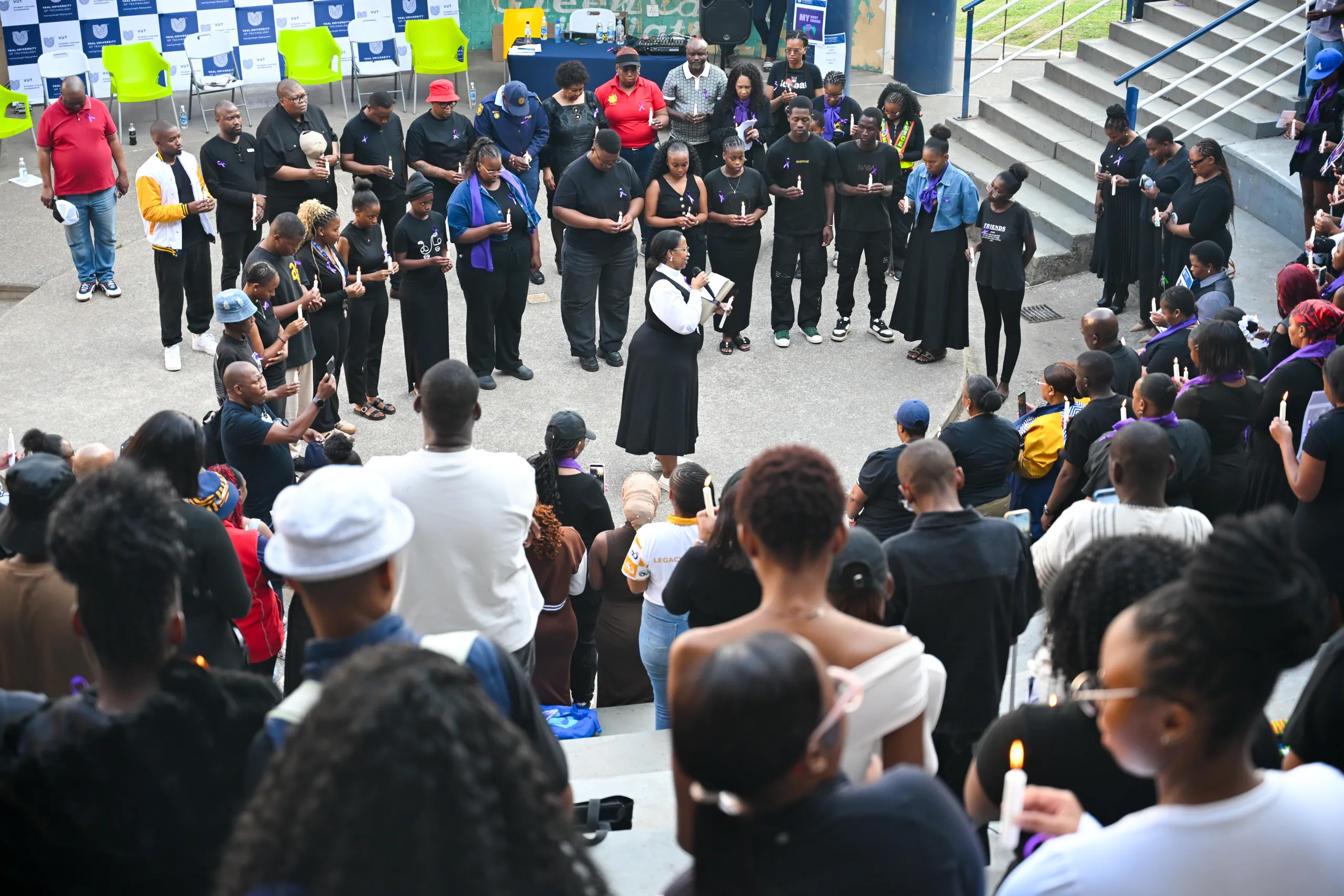
The most emotional moment of the day came during a candlelight ceremony led by VUT Chaplain, Ms Fihliwe Mvundla, in memory of deceased VUT students.
As candles illuminated the gathering, the conversation shifted from policies and procedures to people. The flickering lights served as a powerful reminder of lives lost, dreams interrupted and families forever changed by violence.
It was a moment of reflection, grief and collective commitment. For many in attendance, it reinforced why the fight against gender-based violence cannot be reduced to an annual campaign or awareness event.
The message from the day was clear: wearing black was only the beginning.
For VUT, the real measure of success will be whether awareness turns into action, whether survivors receive the support they need and whether students can move through campus and their communities without fear.
Because for every student pursuing a qualification, safety is not a privilege. It is a basic condition for learning, growth and the opportunity to build a future.