
“VUT first-year students celebrate South Africa’s diverse cultural heritage through food, traditional dress and hospitality at the Heritage Feast.”
06 October 2026 | Story by: Tayron Mhlongo | Picture: Siphephelo Dlamini
5 minutes read time.
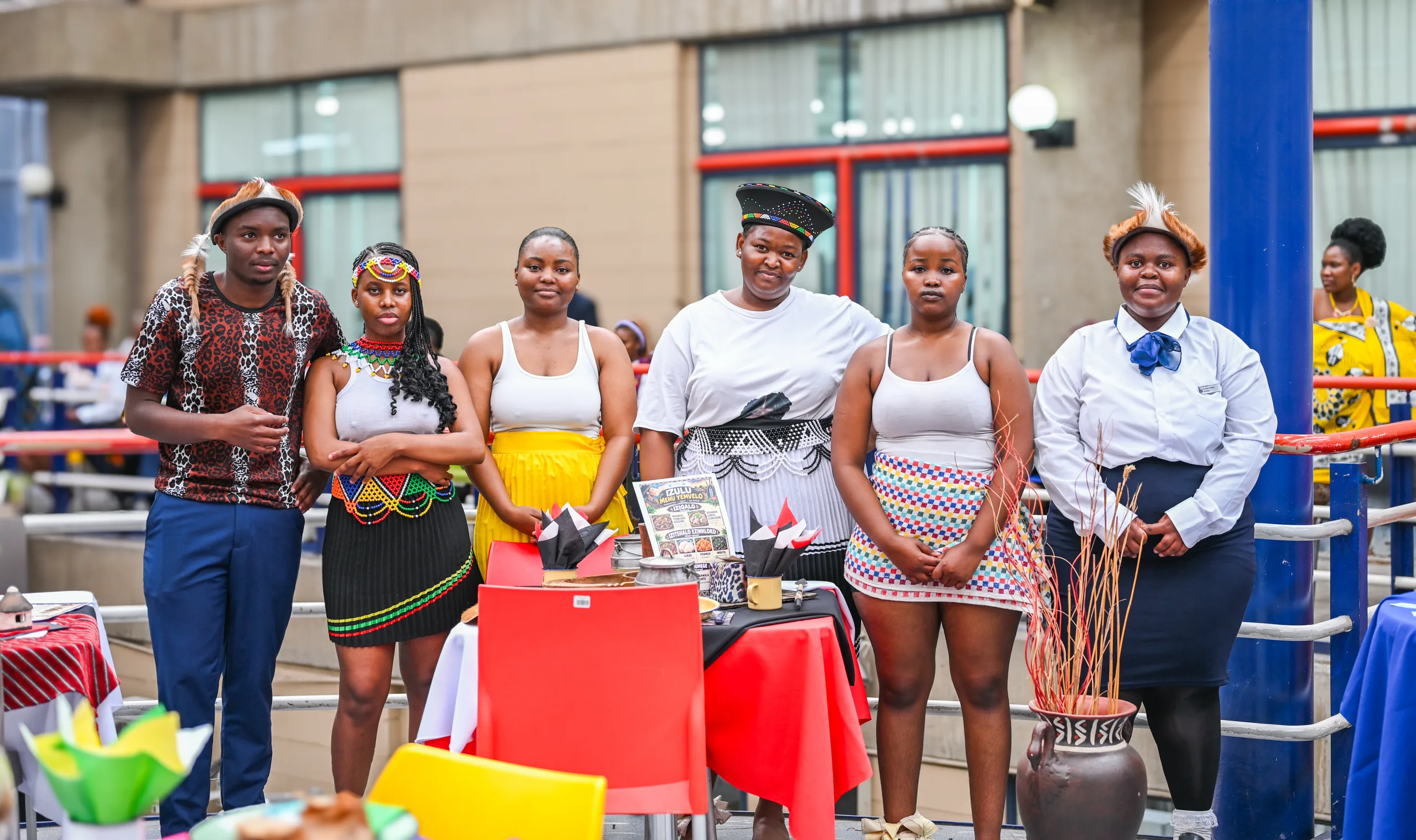
From the aroma of indigenous ingredients to the colours of traditional dresses, the Vaal University of Technology (VUT)’s Heritage Feast transformed food into a celebration of identity, belonging and South Africa’s rich cultural diversity.
Hosted by the Department of Hospitality, Tourism and Food Services Management on 22 September 2026, the event brought first-year students together to commemorate Heritage Day through food, storytelling and creative cultural presentations. More than a celebration, the occasion became a living classroom where heritage, academic learning and innovation came to practice.
As part of their Hospitality Management module, first-year students completed a table-setting assessment inspired by South Africa’s diverse cultural heritage. Working in groups, they researched different cultural food traditions, prepared themed menus and presented their dishes through carefully designed table displays.
From the arrangement of the tables to the choice of ingredients, clothing and presentation style, each group used food to tell a story. The result was a vibrant feast for the senses, demonstrating the students’ creativity while introducing them to the cultural sensitivity, teamwork and attention to detail required in the hospitality industry.
Adding depth to the celebration, guest speaker Dr Vuyo Seti-Sonamzi, a lecturer in the Department of Tourism and Integrated Communication, encouraged students to look beyond food as something prepared, served and consumed.
Her address challenged students to reflect on whose knowledge is recognised, whose traditions are represented and whose food histories have been excluded from formal institutions. She placed the conversation within the broader project of decolonising education, institutional spaces and systems of power.
“How does the African or how does the marginalised fit into a space that was designed without them in mind?” she asked.
The question invited students to examine how African food knowledge has often been overlooked, fragmented, or presented through perspectives that do not fully reflect the communities from which it originates. It also encouraged them to view their own cultural backgrounds as valuable sources of knowledge rather than as traditions that belong outside the classroom.
To guide this process, Dr Seti-Sonamzi introduced three principles for reclaiming African food heritage: remember, remember and reclaim.
The first “remember” calls on people to reconnect with indigenous food sources that existed before conquest and colonial disruption. The second is a reminder to bring together knowledge and practices that were separated over time, restoring connections between food, family, land and community. Finally, “reclaim” calls on people to recover and celebrate what was marginalised, lost or deliberately pushed aside.
Her message extended beyond the event. Dr Seti-Sonamzi urged students to become researchers of their own heritage and encouraged them to explore the possibility of reviving Indigenous Food Knowledge Systems as an important area of study. In doing so, students can help ensure that traditional knowledge is not only preserved, but also documented, respected and applied in contemporary hospitality and food industries.
The students’ presentations reflected the value of learning through participation. Ms Kgomotso Mpudi, whose group prepared indigenous food associated with Khoisan heritage, described the experience as both productive and rewarding.
“We were very productive, and it turned out to be a good experience after all,” she said.
For Ms Mpudi and her group, the assessment was also an opportunity to express cultural pride through their food, table setting and Khoisan-inspired attire. Their presentation demonstrated how academic tasks can create space for students to engage with heritage in a practical and meaningful way.
Ms Tsholofelo Moloi, whose group prepared Indian food and wore clothing reflecting their culture, said the project required careful planning but ultimately became an enjoyable learning experience.
“It was stressful, but we pulled through. We came with a plan, and it was really nice learning new things, mainly about Indians and preparing their food,” she said.
The two reflections captured the broader purpose of the Heritage Feast: to encourage students to learn from one another while recognising that South African identity comprises many interconnected cultural experiences.
In her closing remarks, Senior Lecturer in Hospitality Dr Kudu Marumo-Ngwenya praised the first-year students for delivering an outstanding Heritage Feast. She acknowledged the significant growth they had demonstrated in a short period and commended them for applying their classroom knowledge with confidence and creativity.
Dr Marumo-Ngwenya also thanked the colleagues who have supported the initiative over the past three years. Their continued commitment has helped establish the Heritage Feast as a meaningful platform for cultural learning, practical assessment and student development.
She reminded students that the event was not simply about one day of celebration. It was also about preparing them for a globalised food and hospitality industry in which cultural awareness, authenticity and innovation are increasingly important.
The students were encouraged to take pride in South African traditions, indigenous ingredients and diverse cuisines while considering how these can create future opportunities. Such
possibilities include restaurants, food enterprises and hospitality experiences that showcase local knowledge and celebrate the richness of the country’s culinary heritage.
For VUT, the event held additional significance as the University celebrated 60 years of academic excellence. The students’ dishes and cultural presentations honoured the institution’s legacy while pointing towards a future shaped by creativity, inclusion and practical innovation.
As VUT looks ahead through Strategy 2033+, which positions the institution around digitally smart, sustainable industrial progress and socio-economic transformation, initiatives such as the Heritage Feast demonstrate how learning can remain rooted in community, culture and lived experience