
“VUT hosted the Second Walter Sisulu Memorial Lecture under the theme “Stolen Tomorrows”, calling for ethical leadership, youth opportunity and renewed action against corruption, inequality and social injustice.”
05 August 2026 | By: Ntebogeleng Digasu | Picture by: Peter Masela
4 minutes read time.
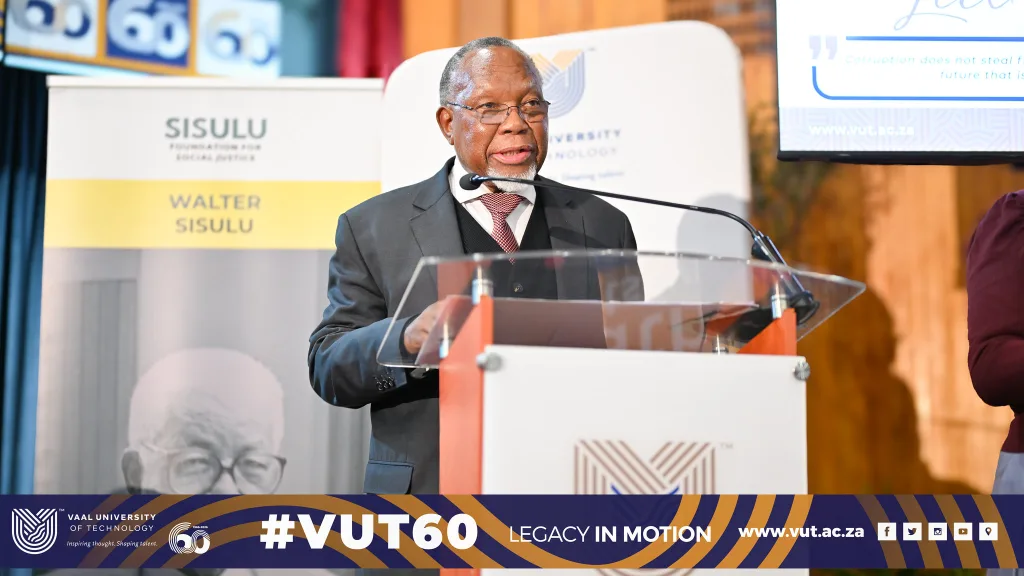
Former President Kgalema Motlanthe addresses the Walter Sisulu Memorial Lecture, honouring a legacy of leadership, service, and unity.
South Africa cannot afford to allow corruption, inequality, unemployment and poor access to quality education to rob another generation of its future.
This was the central call at the Second Walter Sisulu Memorial Lecture, hosted by the Vaal University of Technology (VUT) in partnership with the Walter Sisulu Foundation for Social Justice at the Desmond Tutu Great Hall on 29 July 2026.
Held under the theme, “Stolen Tomorrows”, the lecture brought together political leaders, academics, students, civil society representatives and community members to reflect on Walter Sisulu’s legacy and South Africa’s unfinished democratic promise. The discussion confronted the realities that continue to affect young South Africans, including unemployment, poverty, inequality, gender-based violence, crime and unequal access to quality education.
Mrs Carol Bouwer, television presenter, producer and businesswoman, directed the evening’s proceedings. She said peace, justice and nation building require collective responsibility, with young people placed at the centre of decisions about the country’s future.
“The future of this country belongs to young people, and their voices, ideas and participation must shape the kind of society we build,” said Mrs Bouwer.
In his welcoming address, Professor Khehla Ndlovu, Vice Chancellor and Principal of VUT, said the memorial lecture was not only an occasion to honour Walter Sisulu’s contribution to South Africa’s liberation, but also an opportunity to confront the conditions that deny many young people the chance to realise their potential.
“Universities must not only produce graduates; they must produce responsible citizens, ethical leaders and innovators who will contribute towards solving the challenges facing society,” said Professor Ndlovu.
He challenged students to reject corruption, defend democracy and use their education to restore dignity, create opportunity and uplift communities. Professor Ndlovu also noted Walter Sisulu’s historical connection to the Vaal region, which provided him sanctuary during the struggle against apartheid.
Dr Pali Lehohla, Deputy Chairperson of the Walter Sisulu Foundation for Social Justice, reflected on the legacy of Walter and Albertina Sisulu. He said their lives demonstrated that leadership is grounded in sacrifice, service and a commitment to the public good.
“Walter Sisulu and Albertina Sisulu showed us that leadership is not about personal gain; it is about sacrifice, service and putting the interests of society first,” said Dr Lehohla.
He called for bold policy reform, investment in education, equitable economic development and leadership that places public service above personal gain. He urged young people to challenge injustice, strengthen democratic participation and become active contributors to a united and inclusive South Africa.
Professor Simphiwe Nelana, Deputy Vice Chancellor for Research, Innovation, Commercialisation and Internationalisation (RICI), introduced former President Dr Kgalema Motlanthe, describing his public life as one defined by integrity, humility and service to the nation.
Delivering the keynote address, Dr Motlanthe reflected on the significance of the lecture taking place in the year that marks the 50th anniversary of the 16 June 1976 Soweto Uprising. He said the milestone should compel South Africans to honour the sacrifices of the youth of 1976 while assessing whether the democratic promise made to that generation has been fulfilled.
“Freedom was never intended to be an end. It was meant to create conditions where every South African could live with dignity, access opportunities and participate meaningfully in society,” said Dr Motlanthe.
He said democracy requires ethical leadership, accountable institutions and active citizens who remain committed to protecting the values for which previous generations fought. He called on universities, government, business and civil society to work together to ensure that political freedom is matched by economic opportunity, quality education and social justice.
The lecture was attended by Dr Lindiwe Sisulu, Patron of the Walter Sisulu Foundation for Social Justice and former Minister of Human Settlements, Public Service and Administration, and Tourism, who joined leaders, academics and students in honouring the legacy of Walter and Albertina Sisulu.
Among the audience was Ms Palesa Mokaoledi, Lecturer in VUT’s Civil Engineering Department, who said the lecture reinforced the responsibility of academics and professionals to use knowledge in service of communities.
“Our responsibility as academics and professionals is not only to transfer knowledge, but to ensure that what we teach contributes towards improving the lives of people and communities,” said Ms Mokaoledi.
VUT student Ms Masentle Phadisetsa said the lecture encouraged young people to take ownership of South Africa’s future.
“The lecture reminded us as young people that we are not just observers of the future; we are the builders of it,” said Ms Phadisetsa.
The evening closed with a renewed commitment by VUT and the Walter Sisulu Foundation for Social Justice to preserve Walter Sisulu’s legacy and inspire a generation of ethical, courageous and socially conscious leaders.