
“VUT research seminar examines national belonging, citizenship and undocumented immigration, sparking debate on identity, migration and social justice in South Africa.”
11 November 2026 | Story by: Nontobeko Moimane | Picture: Peter Masela
4 minutes read time.
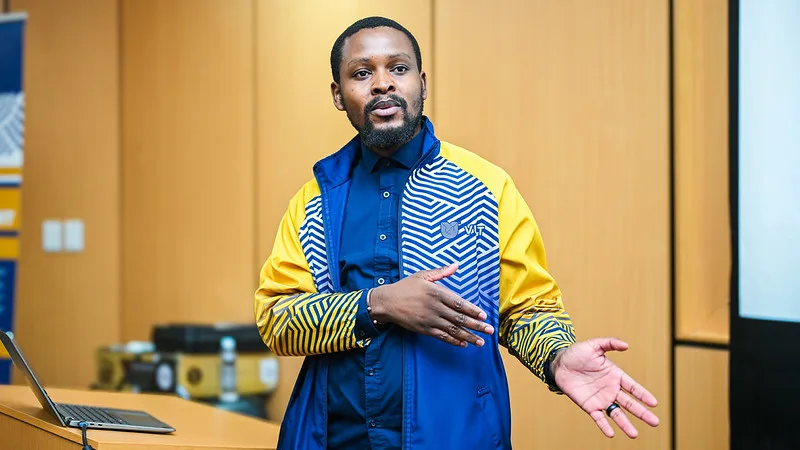
Who belongs in South Africa, and who gets to decide? This question took centre stage during a research seminar at the Vaal University of Technology (VUT), where discussions on national identity, citizenship and undocumented immigration challenged participants to examine the country’s complex history of migration and belonging.
Hosted by the University’s Social Justice and Transformation Unit, in collaboration with the Centre for Academic Development (CAD) and the Research Directorate, the Master’s and Doctoral Staff Research Seminar took place on 3 November 2026 at Auditorium 100.
The seminar brought together students, academics and researchers to engage with contemporary social and political issues, while providing a platform for scholarly debate and the exchange of research perspectives.
Opening the session, Mr George Mvala, Director of the Social Justice and Transformation Unit, emphasised the importance of creating opportunities for intellectual engagement and knowledge exchange. He highlighted the University’s responsibility to nurture emerging researchers and cultivate an academic environment where ideas can be explored, challenged and refined through constructive dialogue.
The seminar featured a presentation by Mr Innocent Siyanda Thwala, an Assistant Researcher whose academic interests include governance, citizenship, public participation and service delivery.
His presentation, titled The Politics of National Belonging: March and March Mobilisation against Undocumented Immigration in South Africa, examined how national identity, migration and citizenship intersect with political mobilisation and competing claims of belonging.
Mr Thwala holds a Bachelor of Arts degree in Public Management and Governance and a Master of Arts in Development Studies from the University of Johannesburg. He is currently pursuing a Doctor of Philosophy (PhD) in Political Studies at the same
institution, with research focusing on the Democratic Republic of the Congo’s civil war and its influence on the country’s foreign policy formulation.
Drawing on South Africa’s history of colonialism, labour migration and changing political systems, Mr Thwala challenged simplified interpretations of national belonging, arguing that the country’s historical experience complicates contemporary distinctions between citizens and foreign nationals.
“South Africa is a country where questions of belonging cannot be separated from its history. People have moved across borders and settled in different places over generations,” he explained.
He argued that debates about who belongs in South Africa must consider the historical circumstances that shaped the country’s population, settlement patterns and national identity.
“South Africa’s history makes the question of who belongs a much more complicated conversation than simply distinguishing between citizens and foreign nationals,” he reflected.
The presentation also explored how concerns about undocumented immigration have become intertwined with broader socioeconomic challenges, including unemployment, crime, poverty, competition for economic opportunities and pressure on public services.
Mr Thwala examined how these concerns can be used to mobilise political support, with migration increasingly becoming a focal point for public frustration.
He further considered the role of political movements and public campaigns in shaping perceptions of citizenship and belonging, while raising questions about the distinction between documented and undocumented migration and the state’s responsibility to manage immigration through lawful and constitutionally grounded processes.
“The issue is not simply about people coming into the country. It is also about how we understand citizenship, documentation, migration and the responsibilities of the state,” he said.
The presentation sparked an engaging discussion, with participants questioning the arguments presented, sharing perspectives and offering suggestions to strengthen the research.
Among those who contributed was Ms Marumo Tsetseoa, a first-year Bachelor of Communication Studies student, who challenged assumptions about national identity and the historical basis upon which individuals claim belonging.
“We don’t know where we all come from. We are all occupying this land because we found our great-grandparents here,” she remarked.
While acknowledging the complexities of national belonging, Ms Tsetseoa also emphasised the importance of proper documentation and effective border management to strengthen immigration administration.
Her contribution demonstrated how questions of citizenship and migration resonate beyond political and academic debates, touching on issues of identity, history and the everyday experiences of South Africans.
The discussion also underscored the importance of balancing effective immigration management with respect for constitutional principles, human dignity and South Africa’s complex historical realities.
Beyond the subject matter, the seminar demonstrated the value of academic engagement in strengthening research. Participants offered feedback on the presentation, including its framing and broader implications, providing an opportunity for the researcher to reconsider arguments and refine his work.
In his closing remarks, Mr Mvala thanked the presenter and participants for their contributions, reiterating the importance of sustaining academic platforms that encourage critical thinking, intellectual exchange and the development of research capabilities.
Through initiatives such as the Master’s and Doctoral Staff Research Seminar, VUT continues to foster interdisciplinary engagement and scholarship that responds to pressing societal challenges.
The seminar reinforced the importance of research in informing public discourse, challenging assumptions and contributing to a deeper understanding of issues that shape South Africa’s democratic development.