
“The Vaal University of Technology’s inaugural Senate Workshop strengthened academic governance, aligned institutional priorities with Strategy 2033+ and advanced academic excellence.”
12 August 2026 | Story by: Tshepiso Kaibe | Picture: Peter Masela
3 minutes read time.
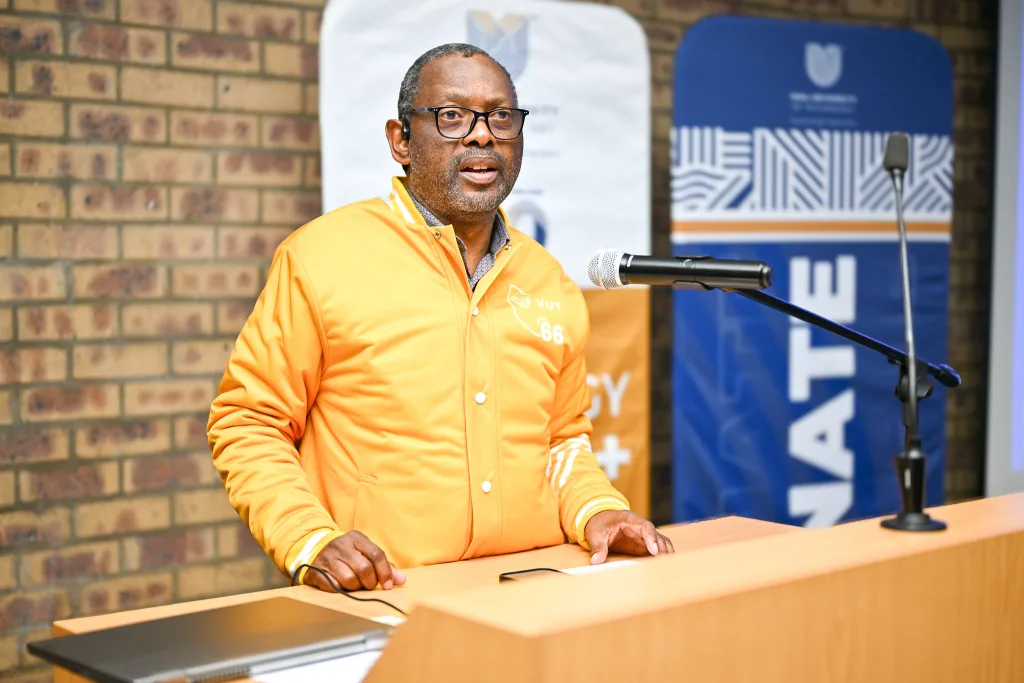
Professor Khehla Ndlovu, Vice-Chancellor and Principal of the Vaal University of Technology (VUT), addresses members of Senate during the inaugural VUT Senate Strategic Workshop held on 4 August 2026.
As the Vaal University of Technology (VUT) continues to commemorate its 60th anniversary, members of the Senate gathered on 4 August 2026 at the VUT Southern Gauteng Science and Technology Park in Sebokeng for an inaugural strategic workshop aimed at strengthening governance, refining institutional priorities and ensuring that the University’s academic leadership remains aligned with its long-term vision.
The workshop brought together Senate members, executive management and other institutional leaders for a day of strategic engagement. It reinforced the Senate’s central role in shaping the University’s academic direction while equipping members with a deeper understanding of the governance frameworks, systems and institutional priorities that will guide VUT into the future.
Setting the tone for the day, Vice-Chancellor and Principal, Professor Khehla Ndlovu, reflected on the rapidly changing higher education landscape and the increasing expectations placed on universities to produce graduates equipped to thrive in an evolving world. He encouraged academics to embrace VUT’s identity as a University of Technology rather than measure its success against other institutions.
“We should not measure our success by trying to become another institution. We need to be proud of ourselves as a University of Technology. That identity is our strength,” he said.
Professor Ndlovu challenged the academic community to think beyond qualifications and focus on producing graduates equipped to create opportunities and solve real-world problems.
“Our mission should not simply be to produce graduates. Our mission should be to produce techno-entrepreneurial graduates,” he said.
That vision echoed throughout the workshop as discussions turned to VUT’s Strategy 2033+ and the Senate’s collective responsibility for advancing its implementation. Participants reflected on how teaching and learning, research, innovation, digital transformation and institutional governance must work together to realise the University’s long-term aspirations.
“One of the things that we are trying to do is to constantly remind the University about the strategy and what has to be done,” said Executive Director for Strategy, Mr David Farirai, emphasising the importance of maintaining a shared institutional focus.
The workshop also reinforced the Senate’s role as the University’s highest academic decision-making body. Through presentations on the VUT Statute, Institutional Rules, Senate Charter and the proposed Senate work plan, members were encouraged to deepen their understanding of the governance framework that guides academic leadership and institutional accountability. They were
also urged to ensure that Senate resolutions are practical, strategic and aligned with the University’s objectives.
Addressing members virtually, VUT Council Chairperson, Professor Mandla Radebe, reflected on the relationship between Council and Senate, describing effective governance as a shared responsibility built on collaboration, accountability and mutual respect.
“No single constituency owns a university,” he said. “Excellence is built on dialogue, on mutual respect, on shared purpose.”
The programme also included updates on initiatives supporting the University’s broader strategic agenda. Senate members were introduced to the BoardEffect governance platform, which is designed to enhance digital governance and improve access to meeting documentation. Updates on infrastructure, information technology, organisational refinement, performance management and procurement also highlighted ongoing efforts to strengthen the University’s operational environment.
In his closing remarks, Professor Ndlovu thanked participants for their engagement and expressed the hope that the Senate Workshop would become an annual platform for reflection and collaboration.
“We should try to do it annually. Today was more just to get you to remember our principles, but also to have a sense of the kinds of things that we’re trying to do,” he said.
By the close of the workshop, one message had resonated throughout the day: strong governance is not confined to meetings and policies. It is ultimately reflected in the decisions that shape teaching, research and the student experience. As Senate members returned to their respective portfolios, they did so with a renewed understanding of their collective responsibility for advancing VUT’s academic mission and translating Strategy 2033+ into meaningful institutional action.