
“VUT’s Entrepreneurship Development Workshop equipped aspiring entrepreneurs with practical skills in innovation, intellectual property and business development.”
12 August 2026 | Story by: Qhawekazi Memani | Picture: Sifiso Nomzaza
5 minutes read time.
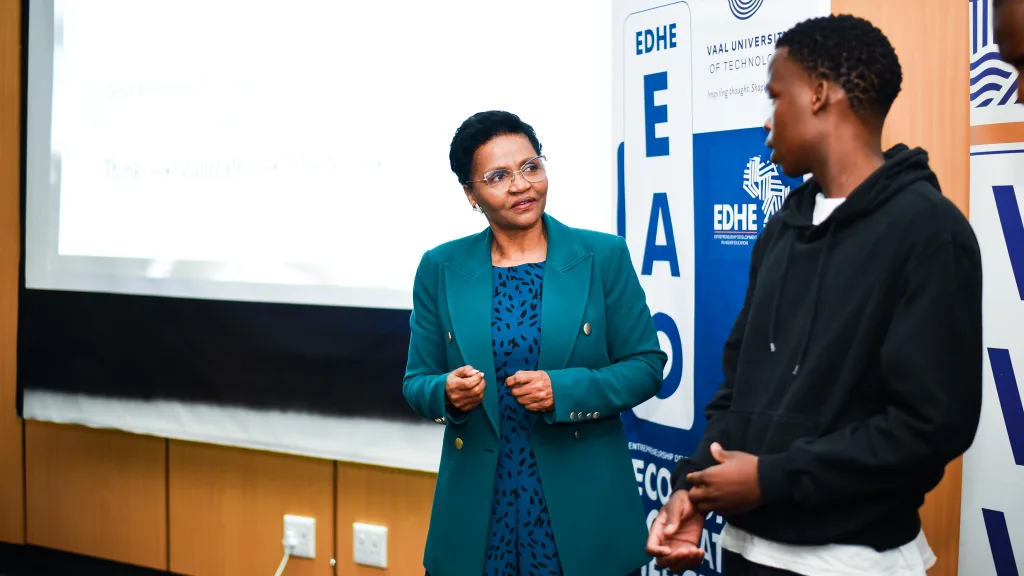
Ms Patricia Chamber-Dlamini joins VUT at the Entrepreneurship Development Workshop, engaging students on innovation, start-up development, intellectual property and commercialisation.
For aspiring student entrepreneurs at the Vaal University of Technology (VUT), turning a promising idea into a sustainable enterprise requires more than ambition. It demands an understanding of customers, innovation, intellectual property and the fundamentals of building a viable business.
These essential skills formed the focus of an Entrepreneurship Development Workshop held on 4 August 2026 at VUT’s Auditorium 100. The workshop was hosted by the University’s Economic Activation Office (EAO), Technology Transfer Office (TTO), based at the VUT Science and Technology Park and Student Life and Governance and The Innovation Hub Company.
Designed to prepare students for the upcoming EDHE ABSA Entrepreneurship InnoVarsity Challenge 2026, the workshop equipped participants with the mindset, practical knowledge and confidence needed to transform innovative ideas into sustainable businesses.
The workshop brought together student entrepreneurs for a day of practical learning focused on innovation, intellectual property, customer discovery and business model development. Through expert presentations and interactive discussions, participants were encouraged to see entrepreneurship not simply as a career option, but as a means of creating employment, driving innovation and contributing to South Africa’s economic growth.
The Programme Director, Ms Mmatshepo Rathebe, Commercialisation Coordinator and the EAO, welcomed participants by highlighting the increasing importance of entrepreneurship in addressing graduate unemployment. She explained that while academic qualifications remain valuable, graduates must also be equipped to create opportunities for themselves and others through enterprise development.
“We need to become entrepreneurs. We need to create employment, innovate and bring change to our communities,” she said. “Not every graduate will secure employment, so we must equip ourselves with the knowledge and skills to build our own businesses.”
Ms Rathebe reminded participants that the workshop formed an important part of their preparation for the internal rounds of the upcoming entrepreneurship competition, during which they would present their business ideas to a panel of judges.
Building on this foundation, Mr Thabo Kgole, Acting Senior Manager of the TTO, introduced participants to the role of innovation and intellectual property in business success. He explained that while many entrepreneurs have promising ideas, those ideas only become valuable when they are transformed into products, services or businesses and adequately protected.
“What we are doing as an office is protecting what your mind creates,” Mr Kgole explained. “Ideas become valuable once they are transformed into products, services or businesses.”
Using familiar examples such as KFC’s “Finger Lickin’ Good” slogan and Netflix’s distinctive start-up sound, Mr Kgole demonstrated how trademarks, logos, slogans, colours and sounds become valuable intellectual property assets that distinguish one business from another. He further explained the role of patents, registered designs and trade secrets in protecting innovation, emphasising that intellectual property should ultimately be commercialised through licensing, partnerships and product development to create sustainable revenue.
Before beginning his presentation, Mr Kgole invited several student entrepreneurs to introduce their businesses to the audience. From mobile phone and laptop repairs to poultry farming, handmade soy wax candles, organic jewellery and herbal teas, the exercise challenged participants to confidently promote their ventures while identifying potential customers and collaborators in the room.
The highlight of the workshop was the keynote address by entrepreneurship specialist Ms Patricia Chamber-Dlamini, who challenged participants to rethink how successful businesses are created. Rather than focusing first on products, she encouraged students to begin by understanding people and the problems they face.
“A product does not create a market; people with needs create a market,” she said. “Successful entrepreneurs understand their customers before they develop or commercialise a product.”
Drawing on practical examples, Ms Chamber-Dlamini explained that successful entrepreneurship begins with customer discovery. She encouraged participants to engage directly with potential customers, identify genuine market needs and validate business ideas before investing time and resources in product development. By
understanding customer challenges, entrepreneurs are better positioned to develop meaningful solutions that create value and remain competitive.
Central to her presentation was the Business Model Canvas, a strategic planning tool that enables entrepreneurs to map every aspect of a business, from customer segments and value propositions to revenue streams, key activities, partnerships and cost structures. She explained that developing a clear business model allows entrepreneurs to make informed decisions, strengthen their value propositions and build businesses capable of long-term sustainability.
The workshop also prepared participants for upcoming business pitch competitions by equipping them with techniques for delivering concise and persuasive elevator pitches. Students were encouraged to communicate their ideas with confidence while demonstrating a clear understanding of customer needs, market opportunities and business viability.
For VUT, entrepreneurship is more than the act of starting a business; it is about developing techno-graduates who can recognise opportunities, solve real-world challenges and create lasting value in their communities. Through initiatives such as the Entrepreneurship Development Workshop, the University continues to nurture innovative thinkers capable of transforming ideas into sustainable enterprises that drive economic growth and social impact.