
“VUT legal advisor Mr Moeketsi Mashiloane says universities must better integrate customary law into legal education to prepare graduates for South Africa’s plural legal system.”
09 September 2026 | Story by: Qhawekazi Memani | Picture: Keitumetse Mokgope
3 minutes read time.
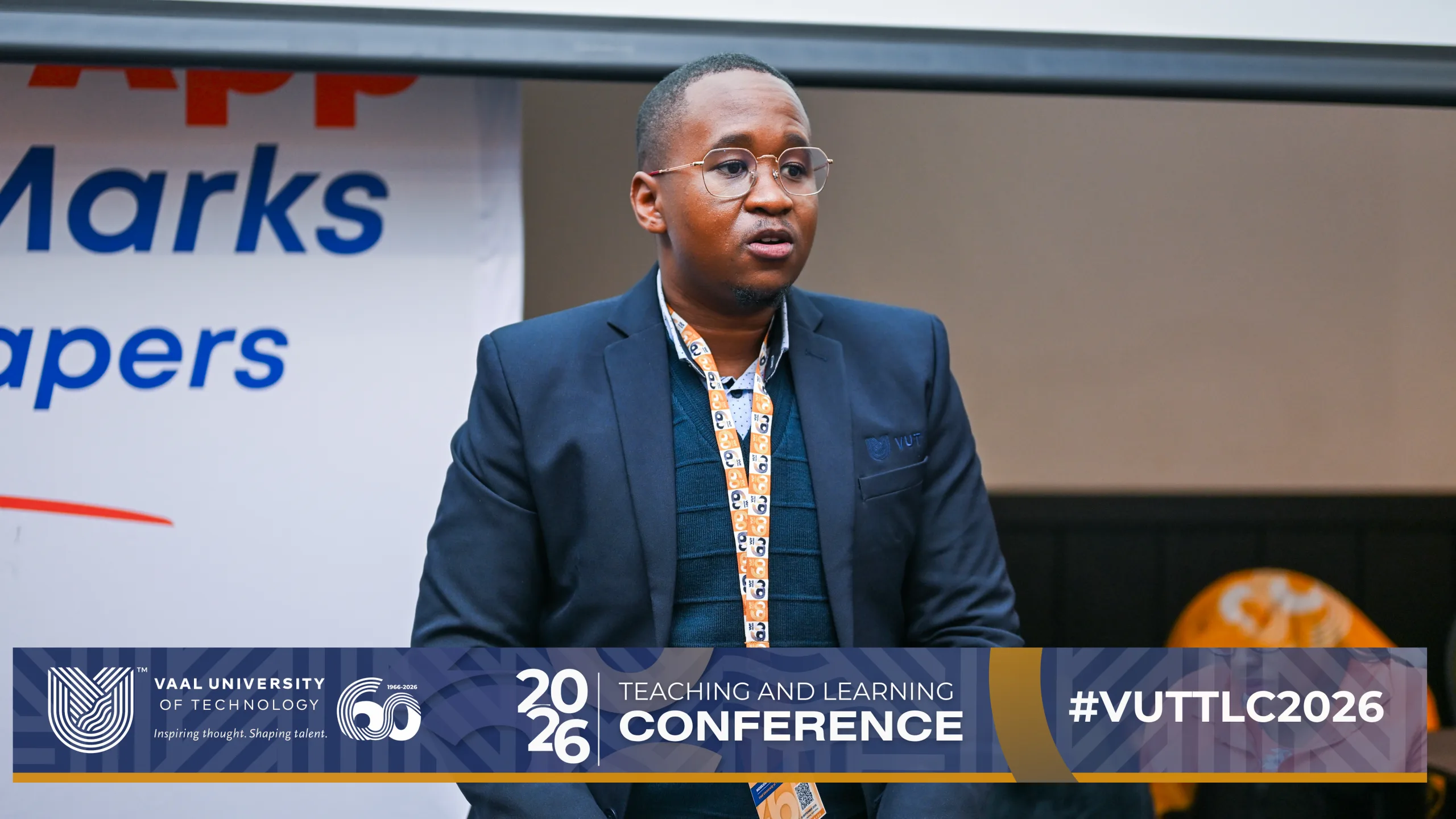
South African universities need to strengthen the teaching of customary law to better prepare future legal practitioners for the realities of the country’s plural legal system, according to Mr Moeketsi Mashiloane, Legal Advisor at the Vaal University of Technology (VUT).
Speaking at the Teaching and Learning Conference at Emerald Tsogo Sun in Gauteng from 8 to 10 September 2026, Mr Mashiloane presented a paper titled Customary Law and Legal Education: Integrating Plural Legal Systems into Teaching and Learning. His presentation explored whether current legal education equips graduates to deal effectively with customary-law matters in professional practice.
He argued that South Africa’s legal framework consists of multiple sources of law, including the Constitution, legislation, common law and customary law.
“South African law is not a single monolithic system,” he said, noting that customary law is constitutionally recognised yet often receives limited attention within legal education.
According to Mr Mashiloane, this gap can leave graduates underprepared for matters involving customary marriages, succession, family relationships, traditional leadership and community-based dispute resolution. He believes universities need to address the issue at its source by reviewing whether customary law receives adequate attention in LLB programmes.
“We ought to ensure that we fix the problem from the root,” he said.
Mr Mashiloane noted that many law graduates go on to become attorneys, advocates, prosecutors, magistrates and judges, professions that require a sound understanding of customary-law principles. Without that foundation, practitioners may struggle to identify applicable customary rules, understand their interaction with legislation and constitutional rights, or apply them effectively in real-world cases.
Using customary marriage disputes as an example, he highlighted the practical challenges that arise when legal professionals are unfamiliar with customary-law principles. He argued that universities should develop graduates who can not only recognise customary law but also identify, interpret, apply and critically engage with it.
A key theme of the presentation was the distinction between official customary law and living customary law. Mr Mashiloane explained that customary law is not static but
evolves alongside the communities that practise it. As a result, legal practitioners must understand the social and cultural context in which customary rules operate.
He further cautioned against treating customary law as uniform across all African communities, stressing that practices differ between communities and require careful consideration on a case-by-case basis.
The presentation also explored the relationship between customary law and constitutional supremacy. While customary law enjoys constitutional recognition, Mr Mashiloane emphasised that it remains subject to the Constitution and must be interpreted within that framework alongside legislation and judicial precedent.
To address current shortcomings, he proposed a more integrated approach to teaching customary law. Rather than limiting it to a standalone module, universities could embed customary-law perspectives across subjects such as constitutional law, family law, succession, dispute resolution and legal practice.
“We need to look at our LLB curriculum,” he said, encouraging institutions to identify opportunities to incorporate customary-law issues throughout legal training.
Conference delegates engaged with the challenges of teaching diverse customary practices within a single constitutional framework. While acknowledging these complexities, Mr Mashiloane argued that diversity should be seen as a reason for deeper engagement rather than a justification for marginalising customary law.
His presentation ultimately formed part of the broader discussion on transforming legal education to reflect South Africa’s social and legal realities. He concluded that universities have a responsibility to produce graduates who can confidently work across the full spectrum of legal sources recognised in the country.
For Mr Mashiloane, strengthening customary-law education is not simply about expanding course content. It is about ensuring that future legal practitioners possess the knowledge and practical skills needed to administer justice effectively in a society where multiple legal traditions continue to coexist.