
“VUT hosted a two-day workshop on medicinal plant research, sustainability, and scholarly writing, strengthening postgraduate research and indigenous knowledge systems.”
17 March 2026 | Story by: Qhawekazi Memani | Picture: Keitumetse Mokgope
Metsotso e 5 nako ya go bala.
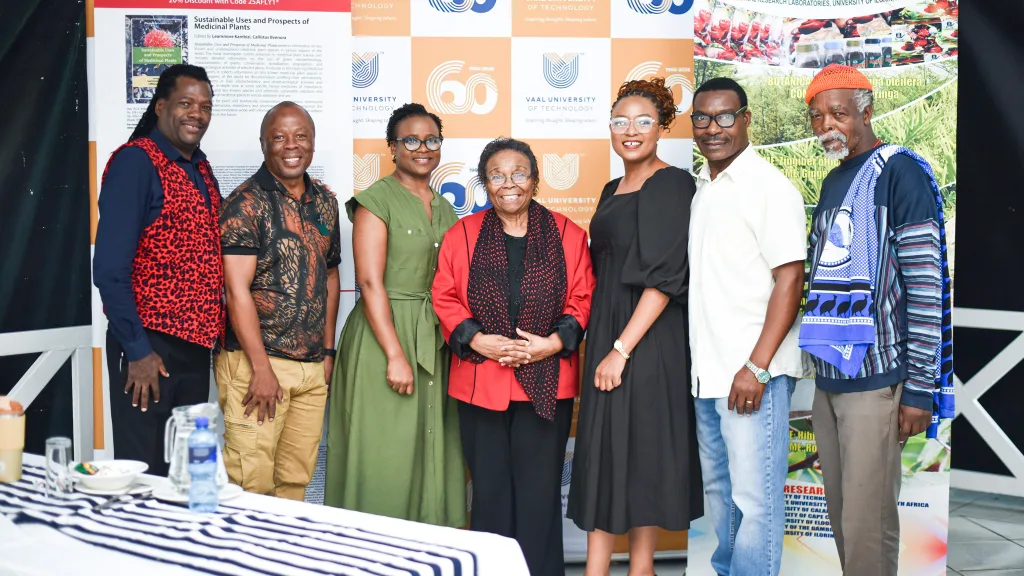
The Vaal University of Technology (VUT) continues to position itself at the forefront of Indigenous Knowledge Systems and sustainable scientific research through a two-day workshop on Medicinal Plant Research, Sustainable Utilisation and Conservation, held at Stonehaven on Vaal from 17 to 18 March 2026.
“Traditional knowledge must be preserved, validated, and protected,” said Dr Sibusiso Xego.
Organised by the Deputy Vice-Chancellor for Research, Innovation, Commercialisation and Internationalisation, Professor Simphiwe Nelana, the workshop forms part of the University’s broader strategy to strengthen postgraduate research capacity while positioning Indigenous Knowledge Systems (IKS) as a critical pillar within South Africa’s scientific and innovation landscape.
The initiative also reflects Professor Nelana’s continued support for revitalising traditional medicine research at VUT, including the 2025 decision to sustain the Indigenous Knowledge Systems Traditional Medicine project as an active research programme within the Institute for Chemical and Biotechnology Technology (ICBT) at the VUT Sebokeng Science Park.
Bringing together postgraduate students, traditional healers, researchers and experts in ethnobotany and conservation science, the workshop introduced participants to the scientific, ecological and ethical dimensions of medicinal plant research. The programme combined short lectures, guided writing exercises, group discussions, peer review activities and practical case studies, creating a collaborative environment that strengthened both research skills and interdisciplinary dialogue.
The sessions were facilitated by Dr Sibusiso Xego and Professor Learnmore Kambizi from the Cape Peninsula University of Technology, who shared their expertise on the study, documentation and responsible use of medicinal plants.
Participants explored the phytochemical properties, pharmacological activities and therapeutic potential of medicinal plants, deepening their understanding of disciplines such as natural products chemistry, pharmacognosy and ethnobotany. Discussions also highlighted the urgent need for conservation strategies, sustainable harvesting practices and responsible cultivation to prevent biodiversity loss while ensuring continued access to traditional medicinal resources.
The second day of the workshop provided deeper institutional and policy context through a presentation by Professor Martha Pinkoane, a leading scholar in IKS. She traced the origins of VUT’s Traditional Medicine and Traditional Knowledge initiative to 2012, when it was established as a community-oriented project aimed at fostering collaboration between researchers and Traditional Health Practitioners in the Sedibeng region.
“The Indigenous Knowledge Systems Traditional Medicine initiative started in 2012 as a novel community-oriented project aimed at building collaboration between researchers and traditional health practitioners,” Professor Pinkoane explained.
Through collaboration with the Chemistry Department, led by Professor Fanyana Mthunzi, traditional herbal remedies were subjected to scientific testing to assess their safety and exclude potential toxicity. This step proved essential in validating the medicines before further community engagement and research activities.
The project gained momentum in 2014 when Professor Nceba Gqaleni, a member of the Expert Working Group on Traditional Medicine, evaluated the work and issued a report supporting further development and funding, ultimately leading to financial support from the Industrial Development Corporation.
Efforts to institutionalise the initiative progressed through faculty and senate structures and received approval in 2018. However, the project lost momentum following the lead researcher’s retirement in 2020.
Professor Pinkoane noted that the initiative was revived in 2025 following engagement with Professor Nelana, who supported its continuation as a research project within the Institute for Chemical and Biotechnology Technology at the Sebokeng Science Park.
“This work is a way forward to ensure that traditional medicines are scientifically validated and ultimately produced responsibly, while traditional health practitioners are able to benefit through commercialisation,” she said.
Where traditional medicines are found to be non-toxic, practitioners will be trained to use biomedical equipment to support clinical observation and improve referral practices for cases beyond their scope of treatment. Subsequent phases will include clinical
observation studies involving human participants, subject to ethical approval, with the University’s Technology Transfer Office (TTO) guiding intellectual property management and commercialisation.
Professor Pinkoane also highlighted her national role on the Department of Health’s Ministerial Task Team, where she contributes to the Expert Working Group on Traditional Medicine. Her involvement reflects growing national recognition of the need to integrate traditional knowledge into formal health and research systems.
In recognition of her longstanding contribution to IKS research, Professor Pinkoane was honoured during the workshop with an autographed copy of Sustainable Uses and Prospects of Medicinal Plants, authored by Professor Learnmore Kambizi and Callistus B’venura. The symbolic handover, witnessed by Prof Nelana, marked a moment of appreciation for her pioneering work in bridging traditional knowledge and scientific research.
Looking ahead, VUT’s work in this field is poised to gain further momentum. The ICBT is scheduled to host a visit from the Department of Science, Technology and Innovation (DSTI) Traditional Medicine Programme on 16 April 2026, followed by a visit from the Chairperson of the Traditional Health Practitioners Council of South Africa (THPASA) in May. These engagements are expected to strengthen institutional partnerships and national alignment in traditional medicine research.
By integrating scientific inquiry, community engagement and ethical commercialisation, the workshop underscores VUT’s commitment to decolonising knowledge production and elevating IKS within mainstream research. As the University continues to expand its work in medicinal plant research and traditional medicine, initiatives such as this are shaping a new generation of researchers equipped to protect biodiversity, validate indigenous knowledge and translate it into sustainable, socially responsive innovation.