
“Foodservice Management students at the Vaal University of Technology (VUT) were inspired to use entrepreneurship and innovation to address food security and community challenges during a Harmony and ENACTUS workshop.”
26 May 2026 | Story by: Siphiwe Sadiki | Picture: Keitumetsi Mokgope
4 minutes read time.
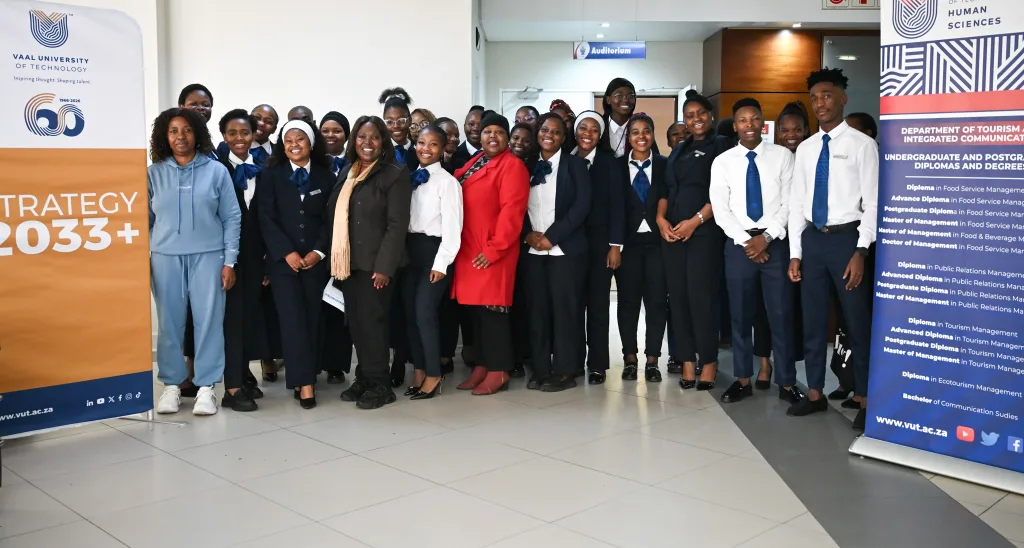
Second year Foodservice Management students from the Faculty of Human Sciences at the Vaal University of Technology (VUT) attended an informative and inspiring HARMONY Food & Health Security, Employability & water scarcity ENACTUS Challenge Information Session held on 20 May 2026 at the VUT African Language Auditorium.
The session was presented by Ms Onica Matsheke and organised by Ms Julia Mofokeng together with Ms Patience Tlhale from the Foodservice Management Department in preparation for next year Harmony challenge.
Addressing the students, Ms Matsheke explained the purpose of the HARMONY Food & Health Security, Employability & Entrepreneurship ENACTUS Challenge, a competition led by Harmony Gold Mining Company in partnership with ENACTUS South Africa. She described the challenge as a platform for student to become social entrepreneurs to design and implement innovative and sustainable solutions across food production value chains, health security, youth employability and water scarcity.
Ms Matsheke further emphasised the importance of the United Nations Sustainable Development Goals, particularly Goal 1: No Poverty and Goal 2: Zero Hunger. She encouraged Foodservice Management students to use the practical knowledge and skills gained through their studies to contribute towards food security, poverty alleviation and employment creation within their communities.
Using the example of the COVID-19 lockdown period, Ms Matsheke reminded students that although many industries were forced to close/ lockdown, the foodservice industry continued operating because food remains an essential human need. She explained that the pandemic highlighted the critical role played by Foodservice Management professionals, as communities relied heavily on food suppliers, retailers, catering services and food distribution systems during difficult times.
She encouraged students to become social entrepreneurs capable of using their qualifications to solve community challenges. According to Ms Matsheke, Harmony and ENACTUS encourage universities to identify communities they can reach and develop sustainable projects that leave a lasting impact. She also guided students through the competition process and explained the assessment criteria used during adjudication.
Students were informed that universities selected to participate in the competition would be announced on 25 May 2026, while the final progress report would be due on Monday, 15 June 2026. The final round adjudication would then be announced on Friday, 19 June 2026.
During the session, Ms Matsheke also introduced students to opportunities provided by Schneider Electric, which encourages electrical and mechanical engineering students to develop alternative energy solutions. She explained that many companies within the Vaal region still depend on externally manufactured batteries, creating opportunities for young innovators to develop local solutions.
During the session, attendees watched videos showcasing the ENACTUS South Africa National Competition presented by Durban University of Technology (DUT) students, highlighting innovative community projects and entrepreneurial ideas developed by university students across the country.
Although registration for the 2026 competition had already closed on 15 May 2026, Ms Matsheke encouraged students not to lose hope, but instead to begin preparing projects for future participation. She suggested that students could initiate community agricultural projects, including practical food production initiatives at the VUT Science Park Campus, as part of future ENACTUS preparation.
“Leave a footprint where you come from,” she encouraged, motivating students to use their education and skills to improve the lives of people within their communities.
Additional contributions during the session encouraged students, particularly those from Limpopo, to consider planting crops such as okra and moringa because of their nutritional and economic value. These crops were highlighted as examples of how indigenous agriculture can contribute towards food security and entrepreneurship opportunities in rural communities.
At the conclusion of the session, second year Foodservice Management student Mr Sifiso Mdaka expressed appreciation for the valuable information shared during the programme.
“The session motivated us to think differently about our qualifications and how we can use our skills to solve community challenges,” said Mr Mdaka. “We learned that entrepreneurship is not only about making a profit, but also about helping communities, creating jobs and fighting hunger.”
Students described the session as educational, motivational and eye opening, with many expressing interests in becoming involved in ENACTUS projects and future competitions aimed at addressing social and economic challenges in South Africa.
The information session successfully empowered Foodservice Management students to think beyond the classroom and recognise their potential to promote sustainable development, entrepreneurship, innovation and community transformation through partnerships such as Harmony and ENACTUS.