
“VUT hosted Professor James Darkwa for a public lecture exploring research commercialisation, innovation, the ‘valley of death’ and the translation of research into real-world solutions.”
12 August 2026 | Story by: Nontobeko Moimane | Picture: Keitumetse Mokgope
Metsotso e 5 nako ya go bala.
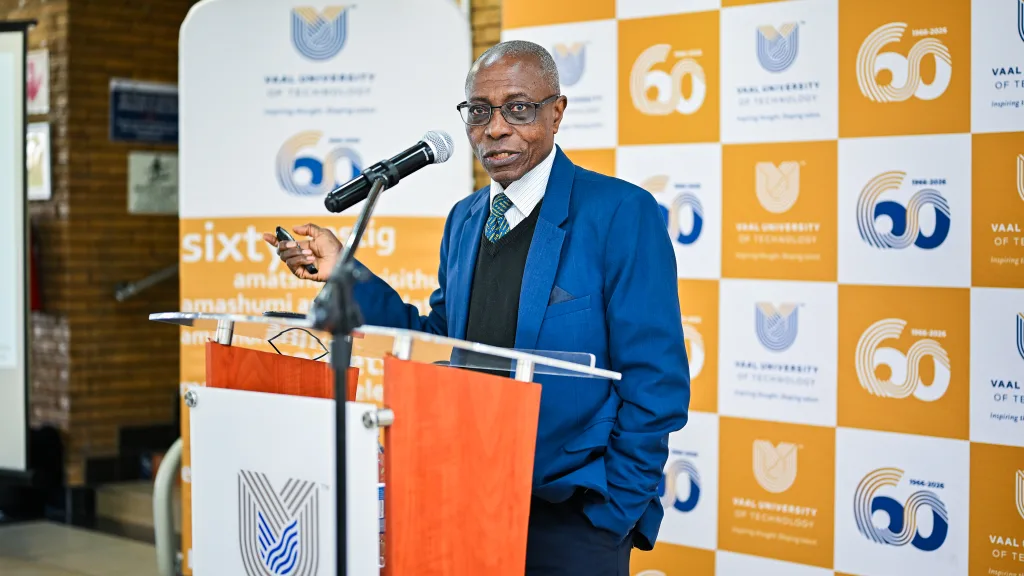
Professor James Darkwa shares insights on innovation, commercialisation and turning research into solutions that benefit society at a VUT public lecture.
The Vaal University of Technology’s (VUT) Faculty of Applied and Computer Sciences, in collaboration with the Office of the Deputy Vice-Chancellor: Research, Innovation, Commercialisation and Internationalisation (RICI), hosted a public lecture delivered by renowned academic and researcher Professor James Darkwa on 5 August 2026 at the Desmond Tutu Great Hall.
In his welcoming remarks, Professor Simphiwe Nelana, VUT Deputy Vice-Chancellor for Research, Innovation, Commercialisation and Internationalisation (RICI), emphasised that universities have a responsibility not only to generate knowledge but also to ensure that their research addresses real-world challenges and contributes to economic and societal development. He said this required researchers to think differently about the work they undertake and, importantly, what happens to it after publication.
“Professor Darkwa’s experience reminds us that the journey from research to innovation and ultimately to commercialisation is not always straightforward. It requires partnerships, persistence, appropriate support systems and an understanding of the various stages between an idea and its successful application,” he said.
The lecture focused on a critical challenge facing higher education and research institutions: how to move research discoveries beyond the laboratory and into practical, commercial and societal applications.
Drawing on his extensive academic and research experience, Professor Darkwa offered researchers and academics a candid reflection on the complex journey from an initial research idea to innovation, commercialisation and, ultimately, meaningful impact.
He emphasised that research should not only seek to understand how things work but also consider what it can ultimately achieve and how it can benefit society. He explained that the value of research does not necessarily have to take the form of a physical product; it can also be something that changes how people live, work or solve problems.
One of the key messages from the lecture was the importance of understanding the different stages involved in transforming research into innovation. Professor Darkwa explained that the journey can begin with an idea and a proof of concept, followed by prototyping and testing, before a technology is sufficiently developed for real-world application.
He also introduced the concept of the ‘valley of death’, which researchers can encounter when attempting to move an invention from research and development towards commercialisation. This stage can be particularly challenging because promising research may require additional funding, partnerships, expertise and infrastructure before it can reach the market.
Using examples from his own research journey, Professor Darkwa demonstrated that successful commercialisation rarely follows a straight line. Researchers may encounter technical, financial, institutional and partnership challenges along the way.
Professor Darkwa shared several examples of research projects aimed at addressing real-world challenges, including the development of compounds with potential medical applications, environmentally conscious industrial processes, water purification technologies and filtration materials.
One notable example involved the development of nanofibre-based filtration technology. The research explored the use of nanofibres to produce filters capable of purifying contaminated water, with the potential to provide portable access to clean, safe drinking water.
He also reflected on research into filtration materials for medical masks, particularly during the COVID-19 pandemic, demonstrating how research can respond to urgent societal needs.
Another example focused on mineral beneficiation, highlighting the economic opportunities that can emerge when researchers look beyond the extraction and export of raw materials and towards processes that add greater value to South Africa’s mineral resources.
Reflecting on the lecture, Dr Lonwabo Ngodwana, Senior Lecturer in Chemistry at VUT, commended Professor Darkwa for sharing both the successes and challenges involved in advancing research beyond the laboratory.
Dr Ngodwana noted that while innovation presents significant opportunities, researchers also need to understand the systems required to support innovation and commercialisation. He called for stronger incubation and support mechanisms to help researchers navigate the journey from promising ideas to viable innovations.
The lecture also prompted reflection from the audience, with Ms Carol Motale, VUT Lecturer in Health Sciences, describing Professor Darkwa’s presentation as an honest and courageous account of the journey from laboratory discovery to commercialisation.
“Listening to Professor James Darkwa share an honest and courageous reflection on his remarkable journey from laboratory discovery to commercialisation, including the dreaded ‘valley of death’, will definitely help researchers to walk that path with purpose and not to stumble blindly,” said Ms Motale.
The public lecture provided an important platform for academics, researchers and members of the University community to engage with the realities of research commercialisation while exploring opportunities to strengthen the connection between knowledge creation, innovation and societal impact.
The event reinforced the importance of building a research culture that does not stop at publication but instead actively pursues impact, innovation, partnerships and the potential for research to address real-world challenges.
Closing the programme, Mr Vido Kungune, representing the University’s internationalisation portfolio, expressed appreciation to Professor Darkwa for sharing his knowledge and experience with the VUT community before presenting him with a token of appreciation.
For VUT, the engagement served as a timely reminder that the journey from research to impact requires more than a good idea. It requires collaboration, persistence, appropriate support systems and a willingness to navigate the difficult path between discovery and application.