
“Dr Otunniyi Temidayo explored how artificial intelligence can enhance teaching and learning while highlighting the importance of ethics, governance and responsible adoption at the VUT Teaching and Learning Conference 2026.”
14 September 2026 | Story by: Sadiki Siphiwe | Picture: Keitumetse Mokgope
4 minutes read time.
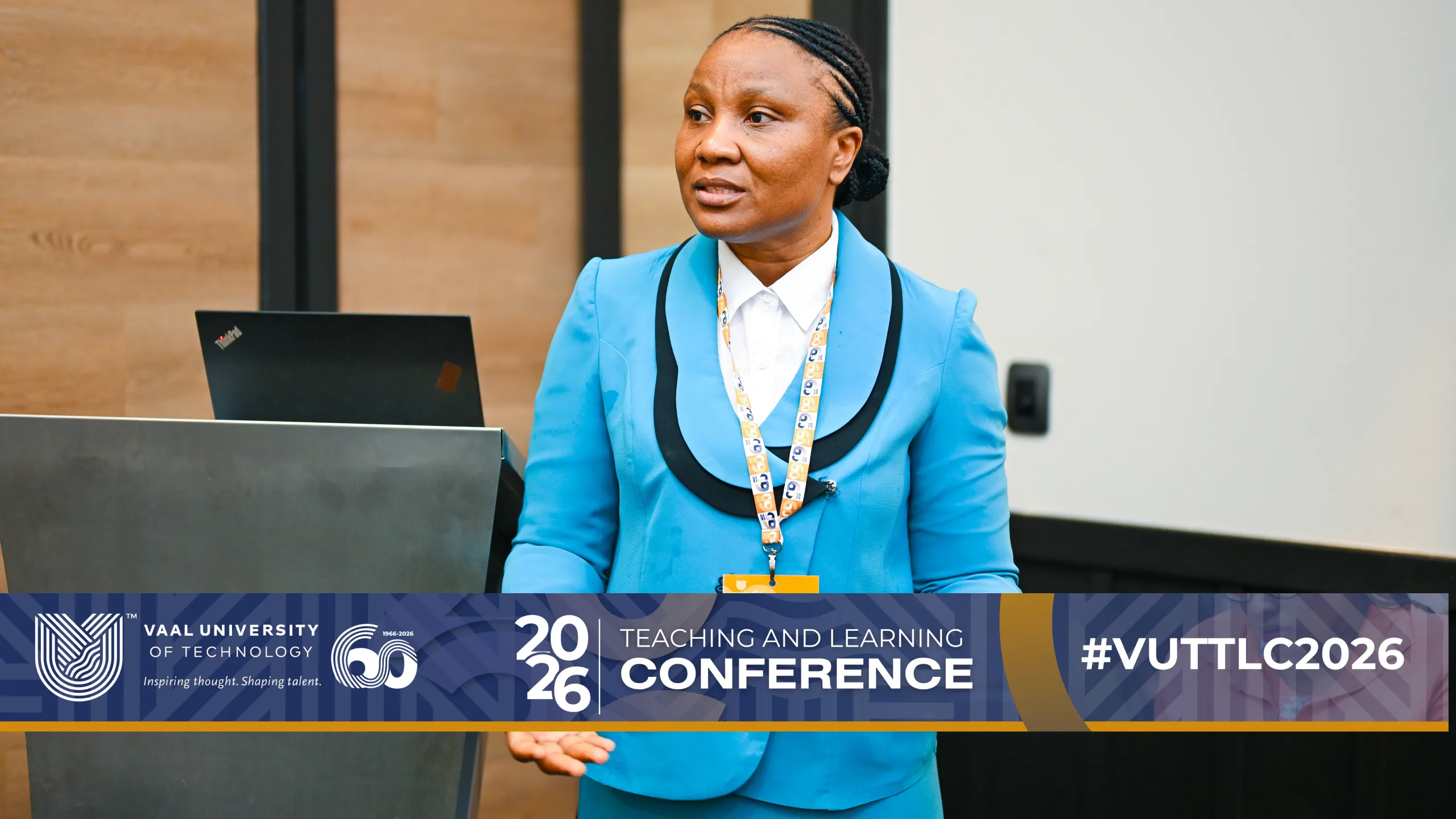
As artificial intelligence becomes increasingly embedded in higher education, universities must ensure that technology strengthens teaching rather than replacing the human judgement, creativity and mentorship that educators provide. This was the message shared by Dr Otunniyi Temidayo, a lecturer in the Department of Engineering at the Vaal University of Technology (VUT), during the VUT Teaching and Learning Conference held from 8 to 10 September 2026 at Emerald Resort and Casino in Vanderbijlpark.
Presenting under the conference theme, Reimagining Teaching and Learning for the Future: Innovation, Inclusion and Impact in Higher Education, Dr Otunniyi delivered a paper titled AI & Emerging Technologies in Teaching and Learning: A Systematic Review, Framework, Challenges & Future Directions.
Her presentation examined how artificial intelligence and emerging technologies are transforming teaching and learning across the world, creating new opportunities for personalisation, accessibility, engagement and student success.
“Higher education is being reshaped by AI, machine learning, natural language processing, computer vision and generative AI,” she said. “ChatGPT and other generative AI systems have accelerated this shift, prompting global conversations about responsible, human-centred adoption.”
Drawing on a comprehensive review of international research and policy documents, Dr Otunniyi highlighted the growing role of technologies such as adaptive learning systems, extended reality, virtual laboratories, robotics and learning analytics in modern education environments.
She explained that these technologies have the potential to provide personalised learning experiences, improve access to educational content, support rapid feedback, enhance student engagement and assist educators with lesson preparation and assessment. At the same time, universities must carefully manage the risks associated with their adoption.
“We have ethical and social risks,” she said. “Privacy and data protection require strong governance and safeguards, while algorithmic bias can reproduce existing inequalities. Generative AI also raises important questions around academic integrity.”
Dr Otunniyi warned that higher education institutions cannot afford to overlook challenges such as digital inequality, unreliable AI-generated content and the need to equip educators with the skills required to use these technologies effectively.
“Teacher preparedness is critical,” she said. “Educators need skills in prompt design, verification and assessment redesign. Moreover, we must avoid over-reliance. AI should augment, not replace, independent reasoning and teacher judgement.”
A key feature of her presentation was the introduction of the AI and Emerging Technologies Teaching and Learning Framework (AI-ETTLF), which proposes a structured approach to institutional AI adoption. The framework is built around five foundations: leadership and governance, digital transformation, academic innovation, knowledge discovery and ethical AI use.
According to Dr Otunniyi, successful AI integration requires universities to balance technological advancement with sound pedagogy, educator expertise, student agency and responsible governance.
“Effective transformation requires joint optimisation of technology, pedagogy, teacher expertise, learner agency, infrastructure and governance,” she said. “AI should augment, not replace educators.”
The presentation resonated with delegates attending the session.
Mr Ally Jan Smith, a lecturer in the Faculty of Management Sciences and Academic Officer of the VUT Convocation, said the discussion reflected realities already emerging in classrooms across the sector.
“My students are increasingly using generative AI tools in their coursework,” he said. “The challenge for academics is ensuring these technologies support learning rather than replace critical thinking. We need assessment approaches that encourage students to verify information, think independently and use AI responsibly.”
He added that graduates entering the workplace will need both digital competencies and a strong ethical foundation to succeed in an AI-driven economy.
The discussion aligns closely with VUT’s Strategy 2033+, which seeks to position the University as a digitally advanced, socially responsive and globally connected institution. As higher education continues to evolve, the conference highlighted the importance of ensuring that innovation is guided by ethics, inclusion and meaningful impact.
The session concluded with a clear message for educators and institutions alike: while artificial intelligence offers significant opportunities to enhance teaching and learning,
its greatest value lies in supporting, rather than replacing, the human connections that remain at the heart of education.