
“VUT and Rotary Club of Riverside empower ECD centres and community gardeners through the Mapheo Project, advancing nutrition, sustainable gardening and food security.”
17 September 2026 | Story by: Staff Reporter | Picture: Supplied
4 minutes read time.
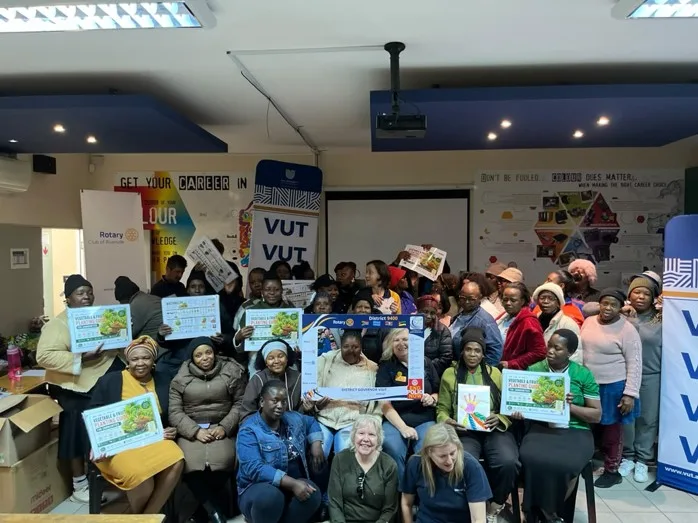
The Vaal University of Technology (VUT), in partnership with the Rotary Club of Riverside, is helping communities strengthen food security by equipping Early Childhood Development (ECD) centres, teachers and gardeners with practical skills that promote healthy nutrition and sustainable food production.
The partnership, implemented through the Mapheo Project, brought together VUT staff, Rotary representatives, gardeners and ECD stakeholders at the Boitjhorisong Resource Centre on 15 September 2026 to celebrate progress made over the past four years and showcase how collaborative community initiatives can create lasting impact.
Since joining the project in November 2022, VUT has worked alongside the Rotary Club of Riverside to support 25 ECD centres across the region. While the initiative initially focused on nutrition education and practical food preparation, it has since evolved into a comprehensive food security programme that addresses the entire food value chain, from production and preparation to responsible consumption.
Through the Department of Tourism and Integrated Communication, academics from VUT’s Food Service Management programme introduced nutrition education tailored to the needs of ECD centres. The training focused on healthy meal preparation, food diversity, effective resource utilisation and strategies for reducing food waste.
As the project developed, attention shifted towards strengthening food production at participating centres. This expansion recognised that long-term food security depends not only on access to nutritious meals but also on the ability of communities to grow food sustainably and manage natural resources effectively.
Over the past two years, VUT has provided gardeners with practical training in sustainable gardening techniques, including vermiculture, crop rotation, companion planting and composting. These methods help improve soil health, increase productivity, encourage biodiversity and reduce waste, creating more resilient food production systems.
One of the project’s most significant achievements is the development of an A3 practical gardening booklet that captures the knowledge shared with gardeners throughout the programme. Designed as an easy-to-use visual guide, the booklet provides practical information on growing a variety of vegetables while illustrating the farm-to-fork concept, helping users understand the connection between food production, preparation and consumption.
The booklet was also incorporated into teacher training sessions, ensuring that knowledge gained through the programme can be reinforced and shared within ECD centres. By providing a lasting
resource, the project helps preserve institutional knowledge and supports continuity even when staff or gardeners change.
Beyond the participating centres, the initiative has the potential to influence household food production. Gardeners are encouraged to apply the techniques learned through the programme in their own home gardens, extending the benefits of the project into families and communities.
Prof Delia Oosthuizen, Associate Professor and Programme Coordinator for Food Service Management in the Faculty of Human Sciences, said the partnership demonstrates how academic expertise can be applied to address real community needs.
“For VUT, the initiative provides an opportunity to demonstrate the University’s commitment to community engagement, sustainability, food security and the practical application of knowledge. For participating ECD centres and gardeners, the programme offers skills and resources that can support healthier food choices, greater food diversity, reduced food waste and more sustainable production practices,” she said.
Her remarks reflect the University’s broader approach to community engagement, which seeks to create practical solutions that communities can understand, retain and apply long after a training session has ended.
The Mapheo Project illustrates the importance of viewing food security as a connected system. Nutrition education supports healthy eating habits, gardening strengthens food production, waste reduction promotes resource efficiency, and sustainable farming practices contribute to long-term productivity. Together, these elements help build stronger and more self-reliant communities.
For VUT, the initiative aligns with its commitment to innovation, sustainability and meaningful community engagement. It also demonstrates how universities can use their expertise to address societal challenges through partnerships that combine research, community knowledge and practical implementation.
The collaboration between VUT and the Rotary Club of Riverside has grown from a nutrition-focused intervention into a multifaceted programme that promotes food security, environmental stewardship and community empowerment. Through practical training, accessible learning resources and sustained support, the project is creating opportunities for lasting change in the lives of children, teachers, gardeners and families.
Ultimately, the Mapheo Project shows that when universities and community partners work together, knowledge becomes more than information. It becomes a resource that can improve livelihoods, strengthen resilience and contribute to a more food-secure future.