
“VUT’s Faculty of Human Sciences examines ethical AI use, equitable access and the changing role of lecturers at its inaugural Teaching and Learning Colloquium.”
22 October 2026 | Story by: Tshepiso Kaibe | Seswantšho: Siphephelo Dlamini ya go swana le yena
Metsotso e 3 nako ya go bala.
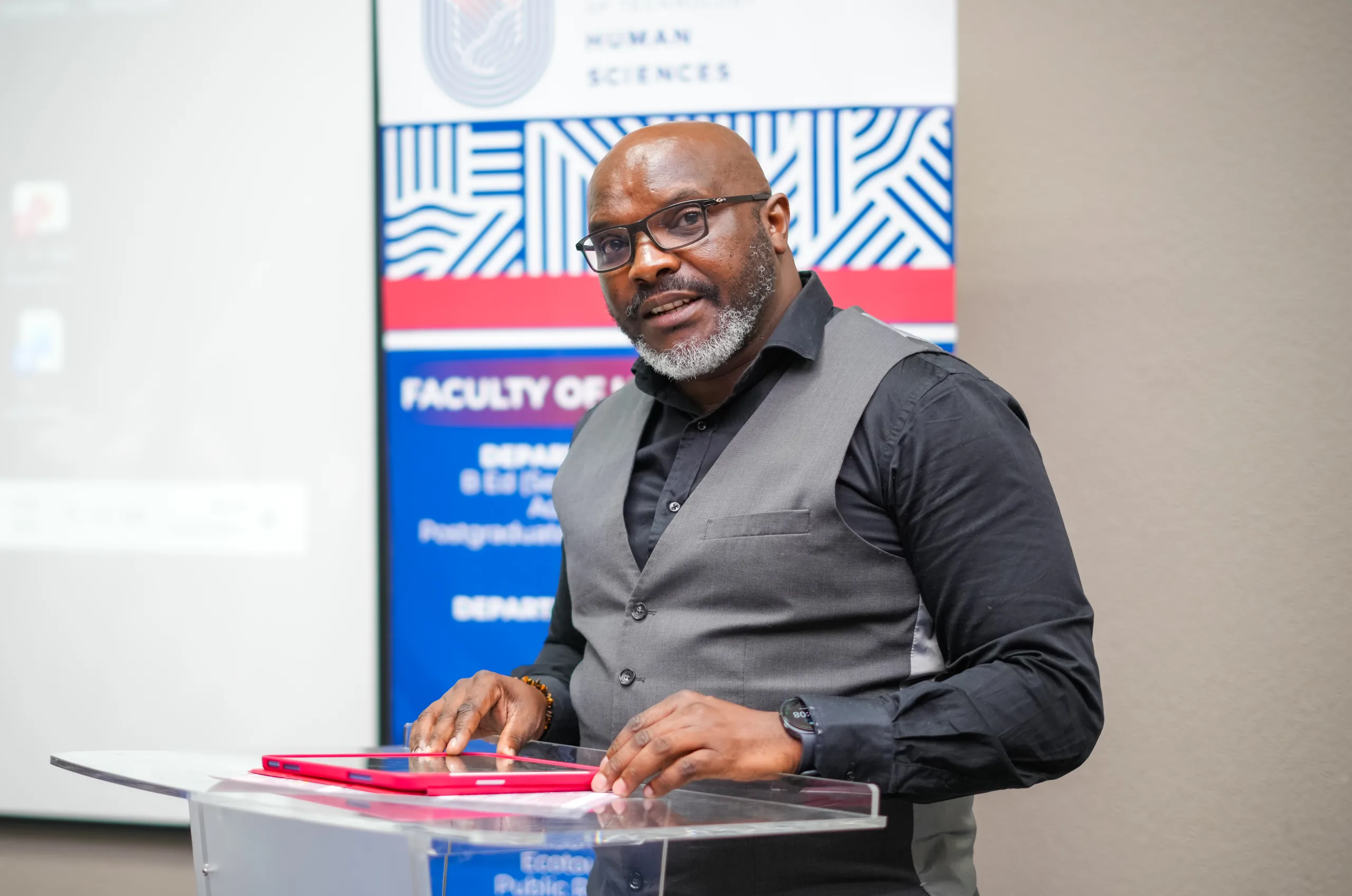
When artificial intelligence (AI) can generate answers in seconds and avatars can deliver lectures, how do universities ensure that students continue to think independently? This question shaped discussions at the inaugural Teaching and Learning Colloquium hosted by the Faculty of Human Sciences at the Vaal University of Technology (VUT).
Held on 13 October 2026 at the VUT Conference Centre, the colloquium brought academics together to examine how AI is changing teaching, assessment and student development. Throughout the discussions, one concern remained central: technological progress must serve the purpose of education.
Opening the engagement, Professor Lazarus Maleho, Executive Dean of the Faculty of Human Sciences, emphasised that the relationship between lecturers and students remains essential to meaningful learning.
“Technology must support education, not replace its human purpose,” he said, adding that AI should not remove students’ responsibility to think independently.
His remarks framed a question that resurfaced throughout the programme: as AI takes on tasks such as explaining concepts, preparing lessons and supporting assessment, how should the lecturer’s role evolve?
Dr Grace Kanakana-Katumba, Deputy Vice-Chancellor: Teaching and Learning, acknowledged that AI was already reshaping higher education. She encouraged academics to help guide this transformation and adapt their teaching so that students develop the ability to apply knowledge beyond the classroom.
“The question should be, how do we sufficiently prepare ourselves and our students in order to shape the transformation process?” she asked.
Professor Tranos Zuva, a Research Professor in VUT’s Faculty of Applied and Computer Sciences, brought these possibilities into focus through a demonstration of AI-generated avatars delivering lectures. The demonstration illustrated how the technology could potentially extend access to explanations and learning support when lecturers are unavailable.
It also prompted questions about transparency, accuracy and academic responsibility. Would students know they were interacting with an AI avatar? How would lecturers verify the information it presented? How could such tools support learning while encouraging students to question and reason for themselves?
“The capability is powerful, but not necessarily reliable,” Professor Zuva cautioned, emphasising the responsibility of those using the technology.
Equitable access was another concern. Students with reliable internet connections and paid subscriptions to advanced AI platforms may have opportunities unavailable to those who depend on university connectivity or free tools. Academics were therefore encouraged to consider how the adoption of AI could affect existing inequalities and what support students would need to participate meaningfully.
These discussions reflected the priorities of the United Nations Sustainable Development Goal 4 (SDG 4), which promotes inclusive and equitable quality education. They also connected with VUT Strategy 2033+ and its focus on technological advancement and the quality of teaching and learning.
Alongside these concerns, participants explored opportunities for AI to support assessment and provide additional learning resources. Such applications could create more space for lecturers to focus on discussion, feedback, mentorship and other aspects of teaching that depend on human interaction and judgement.
For Mr Omoyemi Onawele, a lecturer in the Department of Education within the Faculty of Human Sciences, the gathering offered an opportunity to reflect on these changing responsibilities.
“The teaching and learning colloquium was inspiring and an eye-opener for academics like myself,” he said, adding that the effort invested in organising the event had been worthwhile.
His reflection underscored the value of spaces where academics can exchange experiences, examine emerging practices and reconsider their approaches to teaching.
The colloquium established a starting point for further engagement within the faculty on the responsible use of AI. As these tools become part of everyday academic life, lecturers have a critical role in shaping their use, checking their reliability and ensuring that access is inclusive.
The challenge ahead is to use technology in ways that deepen learning and strengthen students’ ability to question, reason and develop their own understanding.