
“VUT hosts an international lecture that inspires Fine Art students to explore global opportunities, innovation, and social impact.”
04 May 2026 | Story by: Staff Reporter | Picture: Supplied
4 minutes read time.
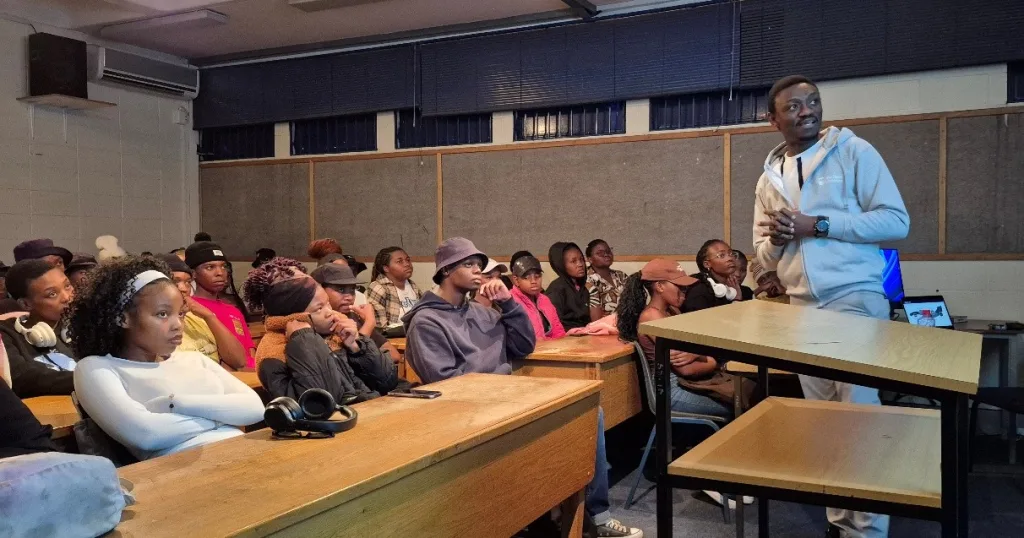
The Vaal University of Technology (VUT) continues to deepen its commitment to globally relevant, socially responsive education, as demonstrated through a recent international lecture that challenged Fine Art students to rethink the role of art in a rapidly evolving world.
Hosted on 29 April 2026, the lecture formed part of the University’s broader strategic thrust to integrate innovation, interdisciplinary thinking, and societal impact into the student experience. It brought into sharp focus the intersection between creativity, functionality, and global relevance.
Dr Folosayo Olalere from the Open University delivered a compelling presentation titled “The Product as an Artwork, the Artwork as a Product: Translating Creative Vision into Use”. His lecture invited students to move beyond traditional artistic boundaries and consider how creative outputs can exist simultaneously as expressions of identity and as tools of value within broader economic and social systems.
A former postdoctoral fellow at VUT (2017–2018), Dr Olalere’s return signalled more than a visit, it marked a continuation of intellectual exchange and collaborative inquiry. During his time at the University, he worked alongside Dr Mashaole Makwela and Mr Thapelo Kgakatsi on a research project addressing one of South Africa’s most urgent societal challenges: Gender-based violence and femicide (GBVF).
The project explores the use of gamification as a tool for awareness and engagement. Fieldwork conducted within the Emfuleni Municipality involved structured dialogues with social workers, activists, facilitators, and counsellors through focused group discussions with local non-profit organisations. This approach reflects an emerging paradigm where art, technology, and social science converge to produce meaningful, community-driven solutions.
Recognising the value of this engagement, the Department of Visual Arts and Design curated the lecture as a platform to expose students to global perspectives and to foreground the evolving relationship between art, design, and social impact.
The session challenged students to reimagine art not merely as aesthetic expression, but as a vehicle for innovation, utility, and influence in both local and global contexts.
Third-year Fine Art student Ms Aphiwe Buthelezi described the experience as both inspiring and confronting. She noted that the lecture deepened her understanding of the relationship between art and design, while also prompting critical reflection on her future. “It made me realise that art is not just about creativity, it also requires planning and direction,” she said.
For first-year student Ms Lerato Machitje, the lecture ignited a renewed sense of purpose. She reflected on the transformative nature of the session, particularly in positioning art as a living dialogue shaped by identity, history, and innovation. “It showed me that our stories as African artists are central, not secondary,” she said. “Art is not just what I create, it is part of a larger ecosystem I can help build.”
She further highlighted the discussion on digital platforms, noting how it expanded her understanding of possibilities such as global collaboration, digital archiving, and academic partnerships that extend beyond conventional gallery spaces.
Another third-year student, Mr Thato Bokgwathile, emphasised the practical insights gained. He pointed to the importance of understanding the global art market and ensuring that artistic work carries both value and functionality. “I learned that my art could reach anywhere in the world,” he said. “As a painter, I now understand the importance of exploring ways to distribute and position my work internationally.”
Beyond individual reflection, the lecture underscored a broader institutional message: that art has a critical role to play in addressing societal challenges. Through the GBVF research project, students were exposed to how creative innovation, particularly through gamification, can be harnessed as a tool for awareness, education, and social change.
This initiative affirms VUT’s commitment to aligning academic excellence with societal relevance, ensuring that graduates are not only skilled practitioners but also conscious contributors to the world around them.
By bringing international expertise into the classroom, the University continues to cultivate an environment where students are encouraged to think expansively, engage critically, and act with purpose.
For many in attendance, Dr Olalere’s lecture was not simply an academic engagement. It was a quiet provocation, a call to stretch the limits of imagination, to anchor creativity in purpose, and to recognise that the canvas is no longer confined to the studio.
It lives in communities, in ideas, and in the future these young artists are now being challenged to shape.