
“Professor Khehla Ndlovu positions universities as drivers of climate action at the ICCRSSF 2026 climate resilience conference in Victoria Falls.”
13 August 2026 | Story by: Tayron Mhlongo | Picture: Supplied
5 minutes read time.
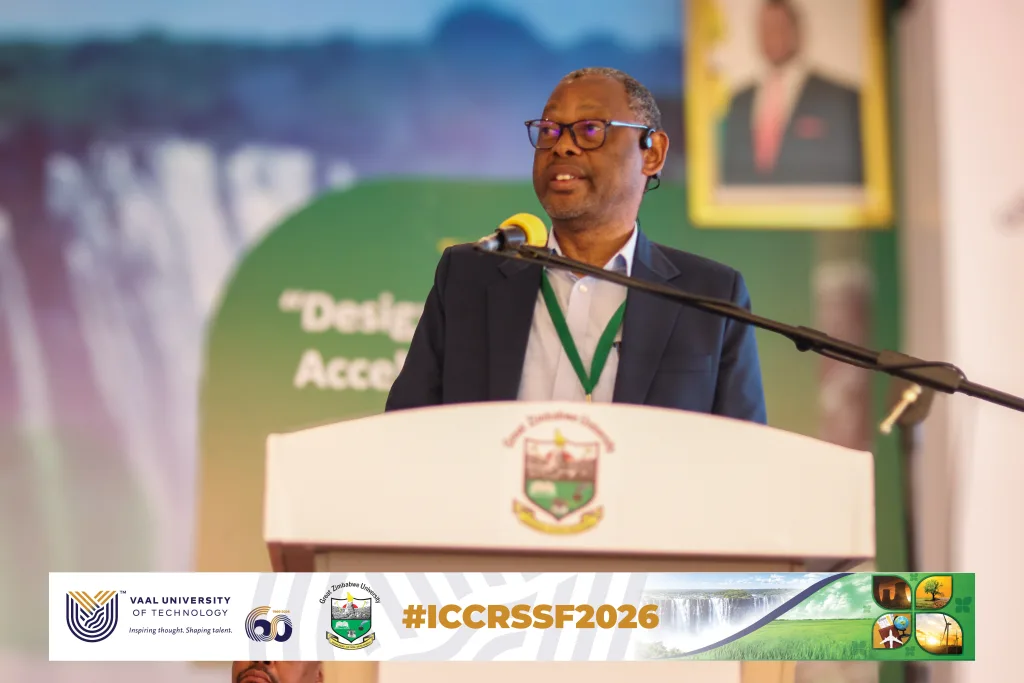
Professor Stephen Khehla Ndlovu, Vice-Chancellor and Principal of the Vaal University of Technology (VUT), delivers his address at the International Conference on Climate Resilient, Smart and Sustainable Futures (ICCRSSF 2026) in Victoria Falls, Zimbabwe.
The much-anticipated second International Conference on Climate Resilient, Smart and Sustainable Futures (ICCRSSF 2026) officially opened on 12 August 2026 at the iconic Elephant Hills Resort in Victoria Falls, Zimbabwe. Running until 14 August, the ICCRSSF 2026 climate resilience conference brings together leading scholars, policymakers, innovators, industry experts and sustainability champions from across the region and beyond for three days of dialogue, knowledge exchange and the pursuit of practical solutions to pressing climate and development challenges.
Hosted by Great Zimbabwe University (GZU), the conference builds on the success and momentum of the inaugural ICCRSSF conference hosted by the Vaal University of Technology (VUT) in 2025.
The 2026 conference theme, “Designing Systems for Accelerating Climate-Resilient and Sustainable Societies,” places a timely and inclusive focus on responding to the intensifying effects of climate change. It highlights the need for innovative systems, sustainable technologies, resilient infrastructure, inclusive policies and indigenous knowledge. The theme recognises that meaningful climate action requires collaboration across disciplines, sectors, communities and nations.
It also connects global commitments with national and continental priorities, particularly the United Nations Sustainable Development Goals, including Sustainable Development Goal 13: Climate Action and Sustainable Development Goal 17: Partnerships for the Goals, as well as the African Union’s Agenda 2063. Through this focus, the conference advances practical pathways towards a more resilient, equitable and sustainable future for Africa and the world.
The central message emerging from ICCRSSF 2026 is clear: the climate crisis cannot be confronted through isolated efforts. In his opening remarks, Great Zimbabwe University Vice-Chancellor, Professor Rungano Jonas Zvobgo, emphasised that climate change transcends borders, disciplines and institutional jurisdictions. Its consequences are visible across agricultural systems, cities, water resources, economies and communities. The response must therefore be equally connected, collaborative and inclusive.
Building on the conference theme, Professor Zvobgo noted that the word “designing” carries particular significance. Climate resilience does not happen by chance; it must be deliberately developed through sound policy, scientific knowledge, appropriate technology, capable institutions, inclusive communities and enduring partnerships. At the centre of this process, he stressed, must be a human-centred approach that responds to the lived realities of vulnerable communities.
Reinforcing this vision, Professor Khehla Ndlovu, Vice-Chancellor and Principal of VUT, emphasised that ICCRSSF has developed beyond the traditional boundaries of an academic conference. He described it as an important continental platform that brings together diverse voices, institutions and sectors to confront the realities of climate change.
He stated that the conference “has become a continental platform for advancing dialogue, strengthening partnerships and identifying practical solutions” to climate change, one of the defining challenges of our generation. His remarks highlighted the importance of moving beyond discussion towards cooperation that produces practical, measurable and sustainable outcomes.
Professor Ndlovu further underlined the important role of higher education institutions in responding to environmental and developmental challenges. He noted that universities have a responsibility that extends beyond the creation and dissemination of knowledge. They must also help shape public policy, strengthen communities and prepare graduates to lead in a rapidly changing world.
As he explained: “We must generate solutions, influence public policy, empower communities and develop graduates capable of leading society through unprecedented environmental and development changes.”
His remarks positioned higher education as a powerful driver of innovation, social transformation and climate action. They also reinforced the responsibility of African universities to ensure that research reaches beyond academic publications and produces tangible benefits for society.
In this context, Professor Ndlovu identified sustainability as an integral part of VUT’s institutional mission. He urged participants to view ICCRSSF 2026 not merely as an academic exercise, but as “a call to action”.
For Professor Ndlovu, the conference represents a meeting of minds committed to transforming knowledge into practical solutions and building a resilient, inclusive and sustainable future. Sustainability must therefore be understood not only as an institutional aspiration, but as a shared responsibility requiring coordinated action from universities, governments, industry and communities.
At the heart of ICCRSSF 2026 lies a growing alliance of academic, government and research institutions committed to advancing practical responses to the climate crisis. This collaborative platform brings together partners such as South Africa’s National Research Foundation (NRF), the Presidential Climate Commission (PCC), the University of South Africa (Unisa), the University of Fort Hare (UFH) and the Cape Peninsula University of Technology (CPUT).
The partnership also includes the Botswana University of Agriculture and Natural Resources and Maasai Mara University in Kenya, among other distinguished institutions. Through this expanding network, the conference seeks to strengthen cross-border knowledge exchange, promote innovative and locally relevant solutions, and confront the rapidly intensifying effects of climate change.
As the world confronts an intensifying climate emergency, the conference comes at a defining moment that demands a decisive shift from fragmented conversations towards integrated,
inclusive and action-orientated responses. Guided by its theme, the conference places practical solutions, cross-sectoral collaboration, knowledge exchange and just transitions at the centre of its agenda.
It creates a dynamic platform where researchers, policymakers, communities, industry leaders and innovators can collectively shape responses that ensure that no person, community or place is left behind.
In this way, ICCRSSF 2026 extends the momentum established by the inaugural conference while reinforcing the forward-looking spirit of VUT’s Strategy 2033+. The strategy reflects the University’s commitment to harnessing innovation, strengthening partnerships, advancing sustainable development and generating meaningful societal impact.
Ultimately, the conference is not merely a forum for exchanging ideas. It is a call to transform knowledge into action and to co-create a smarter, more resilient and sustainable future for generations to come.