
“Dr Jacob Thamaga earns a PhD in Linguistics, exploring communication and semiotic landscapes in Gauteng’s minibus taxi industry.”
17 April 2026 | Story by: Nontobeko Moimane | Picture: Supplied
3 minutes read time.
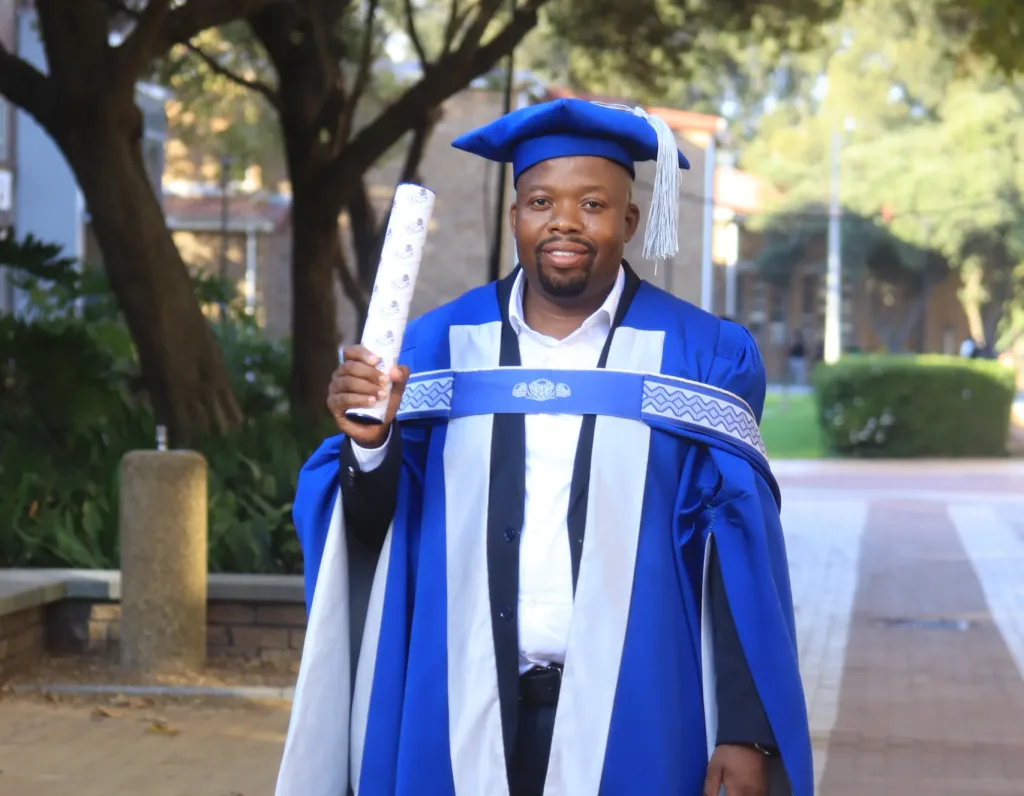
The Vaal University of Technology (VUT) continues to celebrate academic excellence and thought leadership during this graduation period, marked by the achievement of Jacob Twice Thamaga, Manager of the African Languages Development Unit and Chairperson of the VUTFM Board. He was conferred a Doctor of Philosophy in Linguistics by the University of the Western Cape (UWC) on 9 April 2026.
His achievement forms part of a broader moment of pride as VUT celebrates its Autumn Graduation ceremonies from 13 to 24 April 2026, marking the 60th generation of graduates. Within this milestone, his journey reflects the growing depth of scholarship and intellectual contribution emerging from the University.
Dr Thamaga’s doctoral thesis, titled Fixedscapes, mobilescapes and the minibus taxi industry in Gauteng Province: a semiotic landscapes, offers a compelling exploration of how language and communication shape everyday experiences within South Africa’s dynamic public transport system. His research shines a light on the often-overlooked ways in which meaning is constructed and negotiated in the minibus taxi industry, one of the country’s most vital yet complex mobility networks.
A proud son of Ga-Mochemi in Senwabarwana, Limpopo, his academic journey is grounded in determination, discipline, and a deep curiosity about language and society. From his early education in Bochum to completing a Bachelor of Arts in Media Studies and a Master of Arts in Translation Studies and Linguistics at the University of Limpopo, his path reflects a sustained commitment to learning. He further strengthened his academic profile with a Postgraduate Diploma in Sports Development from the University of the Western Cape.
He has successfully integrated his professional role with his academic pursuits, drawing inspiration from both personal passion and the people around him. “My journey was driven by a love for language and storytelling, but also by the people who believed in me, my mother, my wife, and those who encouraged me to keep going even when it was difficult,” he reflected.
At the centre of his research is the concept of semiotic landscapes, the study of language and signs in public spaces. These include road signs, billboards, street names, and informal communication systems that shape how people move, interact, and understand their environment. In the South African context, these landscapes reveal deeper socio historical dynamics, including the marginalisation and gradual resurgence of indigenous languages.
His findings show that communication within the minibus taxi industry extends far beyond written signage. Landmarks, hand signals, oral cues, and sound all work together to facilitate navigation, negotiation, and social interaction. While English continues to dominate commercial signage, indigenous African languages are increasingly shaping regulatory and communicative spaces, reflecting a broader shift towards linguistic inclusivity.
The implications of this work extend into urban planning, language policy, and transport systems. By recognising both verbal and non verbal communication, his research offers practical insights into building more inclusive and accessible public environments.
Balancing doctoral research with professional leadership and family responsibilities was not without difficulty. Leading a strategic unit at VUT while pursuing a PhD required discipline, careful time management, and sustained focus. Yet, through perseverance, he navigated these demands and reached this milestone.
Reflecting on the journey, his message to aspiring postgraduate students is grounded in experience. “You must be clear about why you are doing it. There will be pressure, there will be sacrifice, but if your purpose is strong, you will find a way through,” he said.
As VUT continues to advance its mission of fostering innovation and transformation, his achievement stands as a reminder that education does more than produce qualifications. It shapes how we understand the world, how we communicate within it, and how we imagine its future.