
“VUT unveiled R5 million upgraded science laboratories and a postgraduate learning space, boosting teaching, research and innovation.”
28 July 2026 | Story by: Nontobeko Moimane | Picture: Sifiso Nomzaza
4 minutes read time.
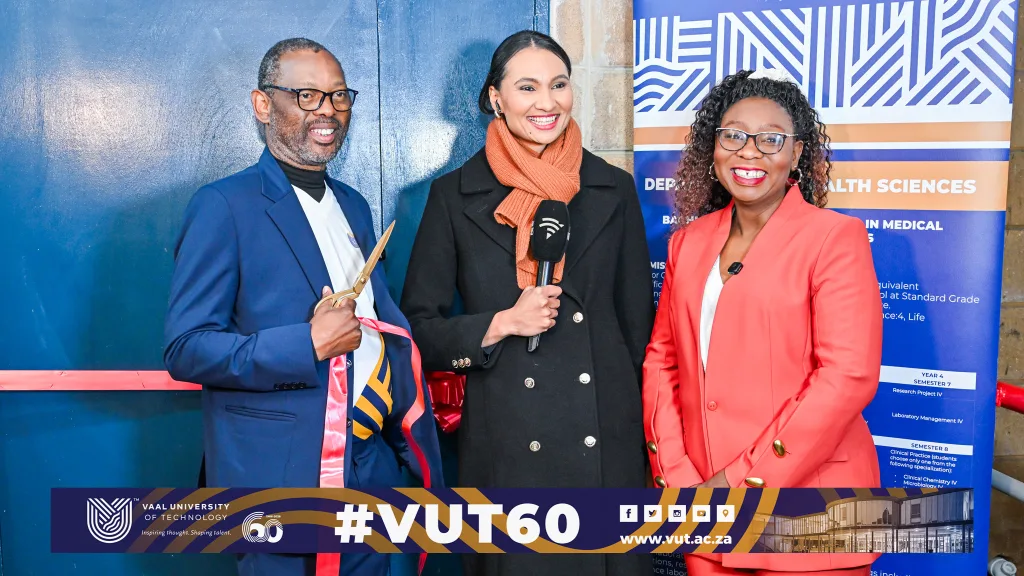
The Vaal University of Technology (VUT) marked a defining moment in its 60-year history with the official unveiling of upgraded science laboratories and a postgraduate learning space at its Vanderbijlpark Campus.
Unveiled on 23 July 2026 as part of the University’s Diamond Jubilee celebrations, the R5 million refurbishment was made possible through a grant from the Department of Higher Education and Training (DHET). The investment modernised six specialist teaching laboratories and one postgraduate learning space in VUT’s existing F and C Buildings.
The facilities will strengthen practical teaching, learning and research in Health Sciences and Chemistry, giving students improved environments in which to test theory, apply knowledge and develop scientific skills.
Opening the programme, Acting Executive Dean of the Faculty of Applied and Computer Sciences, Professor Solly Lebelo, described the occasion as more than a celebration of infrastructure.
“Today is not just another date on the calendar. As we celebrate the 60-year legacy of the Vaal University of Technology, we do so by making meaningful investments towards the future. These laboratories are the incubators of the next generation of South African scientists, health professionals and technologists,” he said.
Professor Lebelo explained that the facilities will serve as engines of innovation, where students translate theory into practical solutions while researchers continue to push the boundaries of scientific discovery.
Providing an overview of the project, Deputy Vice-Chancellor for Teaching and Learning, Dr Grace Kanakana-Katumba, highlighted the University’s strategic shift towards project-based and laboratory-oriented learning.
She said modern laboratories are essential to ensuring that graduates possess the practical competencies demanded by industry.
“We want to produce graduates who know how to do things. Industry requires graduates who can apply knowledge, solve problems and innovate from day one. These laboratories provide exactly that environment,” she said.
The upgraded spaces include the Cell Biology and Genetics Laboratory and the Clinical Pathology Laboratory, which will support practical learning in cellular processes, genetics, laboratory methods and the scientific study of diseases.
Four undergraduate Chemistry laboratories, namely Physical Chemistry, Inorganic Chemistry, Analytical Chemistry and Organic Chemistry, will support experimentation, measurement, chemical analysis, synthesis and the practical application of core chemistry principles. The
dedicated postgraduate sitting space will support advanced study, research preparation, data analysis and academic collaboration.
Delivering the keynote address, Vice-Chancellor and Principal Professor Khehla Ndlovu said the launch embodied the University’s Diamond Jubilee theme by combining reflection on the past with purposeful investment in the future.
“As we celebrate 60 years of excellence, innovation and impact, we are demonstrating our continued commitment to investing in the future. Universities are defined not only by the qualifications they confer but also by the environments they create for learning, discovery and innovation,” he said.
Professor Ndlovu noted that, while VUT continues to make progress on major infrastructure projects such as the Life Sciences Building, the laboratory upgrades show the University’s commitment to improving the student experience now.
“This approach reflects who we are as a University of Technology. We do not wait for tomorrow to improve today’s student experience while we invest in infrastructure for the future,” he said.
He added that the investment extends beyond infrastructure, reaching the student who dreams of becoming a scientist, the researcher pursuing solutions in healthcare, industry and environmental sustainability, and the academic inspiring the next generation of innovators.
The unveiling carried added significance during National Science Month. It followed VUT’s hosting of the national launch on 4 July 2026 at the VUT Gauteng Science and Technology Park in Sebokeng, under the theme Science is for Everyone. The University’s month-long programme also included community science activities and a Winter School that brought more than 500 Grade 12 learners closer to Mathematics, Physical Sciences and future study opportunities.
Delivering the vote of thanks, Director of the Institute of Chemical and Biotechnology, Professor Fanyana Mtunzi, acknowledged the project teams, engineers, contractors, academic staff, technicians and support personnel whose collective efforts brought the facilities to life.
“These laboratories have been built for you. They provide an environment where you will acquire practical skills, develop innovative ideas, conduct meaningful research and prepare yourselves to become the scientists, healthcare professionals and leaders of tomorrow,” he told students.
The upgraded facilities are a practical expression of the future envisaged in Strategy 2033+: a VUT recognised for academic excellence, impactful research, innovation and meaningful societal contribution.