
“As part of VUT’s Staff Promotion Recognition Series, Prof Simphiwe Nelana reflects on his promotion to Associate Professor, highlighting his leadership in research, innovation, postgraduate supervision and Strategy 2033+.”
24 February 2026 | Story by: Qhawekazi Memani | Picture by: VUT
4 minutes read time.
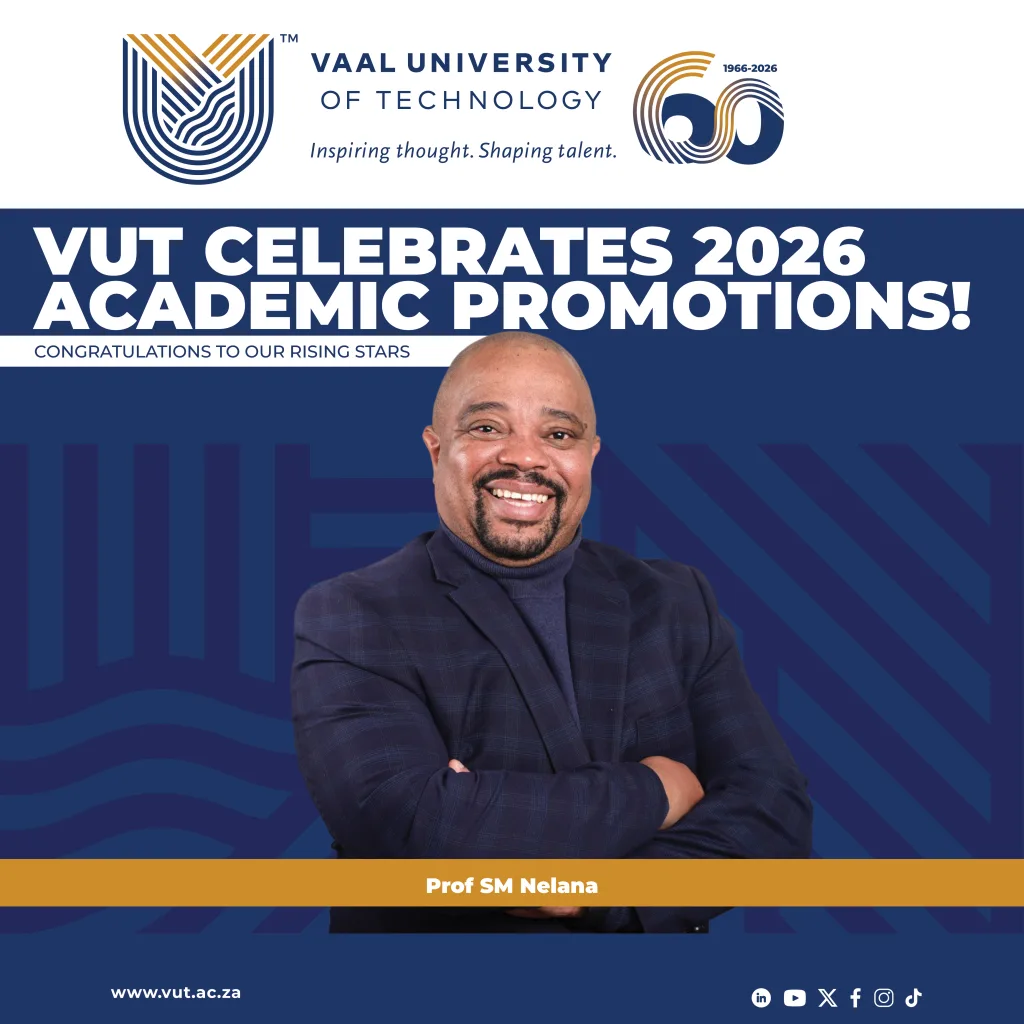
The Vaal University of Technology (VUT) proudly launches its Staff Promotion Recognition Series, a weekly celebration of academics whose scholarship, leadership and dedication continue to shape the University’s trajectory. We begin with Prof Simphiwe Nelana, recently promoted from Senior Lecturer to Associate Professor.
A year into his tenure as Deputy Vice-Chancellor for Research, Innovation, Commercialisation and Internationalisation (RICI), Prof Nelana reflects on his advancement as “a defining milestone in a career shaped by scholarship, executive leadership and institutional transformation.”
“This promotion is not only a personal achievement,” he says, “but recognition of the collective effort of colleagues, mentors, students and postdoctoral fellows who have walked this scholarly path with me.”
For Prof Nelana, the elevation to Associate Professor represents far more than a change in rank. It affirms sustained commitment to advancing applied research, strengthening innovation ecosystems, and ensuring that higher education remains responsive to societal and industrial needs.
His promotion is underpinned by clear and measurable impact. Key contributions that strengthened his academic profile include leadership in research and innovation strategy, postgraduate supervision, policy development, commercialisation initiatives, and the cultivation of strategic partnerships that enhance the University’s reach and relevance.
Despite the demands of executive responsibility, Prof Nelana remains actively engaged in research and postgraduate development. In recent years, he has co-supervised two master’s candidates and one doctoral candidate to completion, while hosting two postdoctoral fellows.
“These achievements demonstrate that sustained academic productivity is possible alongside executive leadership,” he notes.
He maintains that senior university leaders must remain academically active to retain scholarly credibility and effectively guide institutional research agendas. In this regard, from 2026 VUT executives will assume adjunct academic roles, reinforcing alignment between leadership, teaching and research. For him, leadership must not drift from scholarship. It must be anchored in it.
Prof Nelana’s leadership philosophy has evolved over time. What began as individual academic contribution has matured into a systemic institutional outlook. He advocates for strengthening research output through deliberate structural interventions, including:
· Structured mentorship for emerging scholars
· Seed funding and targeted grant writing support
· Incentivised interdisciplinary collaboration
· Alignment of research priorities with national and industry needs
During his tenure as Director of Research, implementing these initiatives resulted in measurable improvements in research participation, publication output and grant competitiveness, particularly among early career academics. The shift was not accidental. It was intentional, strategic and sustained.
He further underscores the importance of commercialisation in ensuring institutional sustainability.
“Commercialisation transforms research into economic value. It supports entrepreneurship and contributes meaningfully to the national innovation system.”
Under his stewardship, commercialisation is positioned not merely as revenue generation, but as a bridge between academic discovery and societal application. Research must move beyond journals. It must live in industry, in communities, and in the economy.
Internationalisation also forms a central pillar of his vision. Prof Nelana emphasises the need to expand the University’s global footprint through strengthened research partnerships, joint academic programmes, increased staff and student mobility, and strategic participation in global sustainability and innovation platforms.
“We must position VUT within global sustainability and innovation agendas,” he explains.
Yet he remains resolute that global engagement must translate into local transformation.
“Knowledge exchange and technological advancement should improve community outcomes and drive socio economic development.”
As the University advances Strategy 2033+, his promotion signals alignment between leadership vision and academic performance. The strategy calls for research excellence, innovation driven growth, and international relevance. His academic progression mirrors these institutional ambitions.
Looking ahead, Prof Nelana is committed to deepening research excellence, expanding international collaborations, strengthening postgraduate development, and consolidating VUT’s innovation ecosystem. The objective is clear: to position the University as a catalyst for inclusive growth and knowledge driven development.
“Academic excellence,” he concludes, “is the pursuit of knowledge that transforms lives through rigorous research, impactful innovation, ethical leadership and meaningful societal contribution.”
In celebrating his promotion, the University not only recognises individual achievement, but also reaffirms its commitment to scholarship that matters, leadership that delivers, and research that changes lives