
“VUT, with PanSALB and partners, hosted the 2026 Gauteng International Mother Language Day, promoting multilingual education, MTbBE and indigenous languages as economic drivers.”
17 February 2026 | Story by: Qhawekazi Memani | Picture by: Sifiso Nomzaza
3 minutes read time.
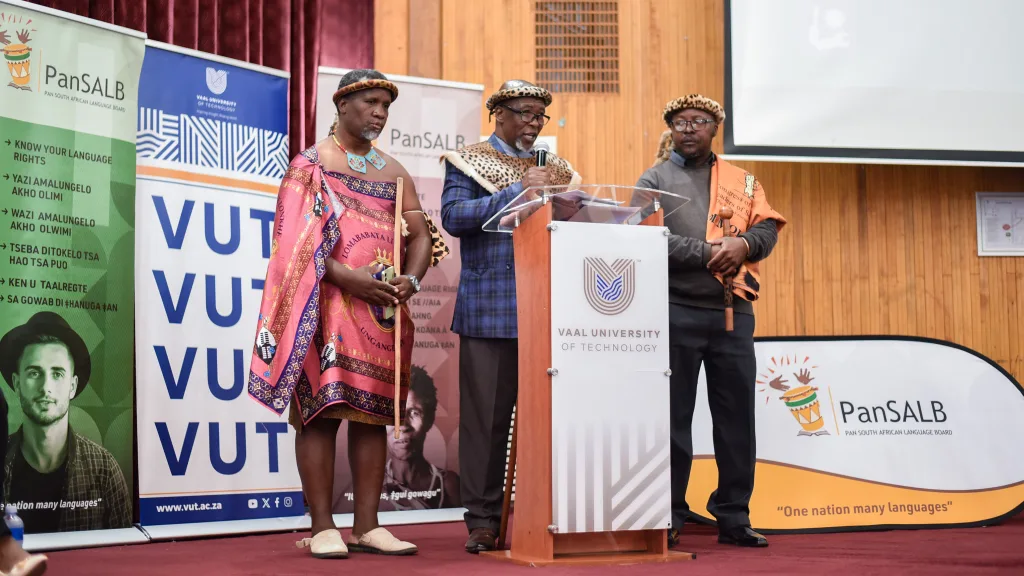
On 16 February 2026, the Vaal University of Technology (VUT), through its Centre for Academic Development (CAD) and African Languages Development Unit (ALDU), in partnership with the Pan South African Language Board (PanSALB), hosted the Gauteng celebration of International Mother Language Day 2026 under the theme “Youth Voices on Multilingual Education”.
Held at the Desmond Tutu Great Hall, the event brought together key stakeholders in language development and education to reflect on multilingualism as a driver of inclusive education, social cohesion and democratic participation.
Representatives from PanSALB, the Gauteng Provincial Language Committee (GPLC), the Gauteng Department of Education (GDE), the Gauteng Department of Sport, Arts, Culture and Recreation (SACR), and the Congress of Traditional Leaders of South Africa (CONTRALESA) were in attendance. VUT students, curriculum and subject advisers, educators, and learners from Khutlo Tharo Secondary School and Setlabotjha Primary School participated, reinforcing the intergenerational focus of the programme.
The event aimed to advance multilingual education, strengthen the implementation of Mother Tongue Based Bilingual Education (MTbBE) in Gauteng, and reaffirm the preservation and development of indigenous languages within public institutions and higher education.
In her welcome address, Ms Elize Heuer, Acting Executive Director for the Centre for Academic Development at VUT, stressed the urgency of safeguarding indigenous languages.
“If we let our languages disappear, our voices and stories will disappear,” she said, underscoring the need for African languages to evolve and find relevance within new technologies and digital spaces.
The keynote address was delivered by Commissioner Tsakane Nkwe of the Commission for the Promotion and Protection of the Rights of Cultural, Religious and Linguistic Communities (CRL Rights Commission).
She reminded attendees that International Mother Language Day is “not simply about remembrance. It is about responsibility,” framing linguistic protection as both a constitutional mandate and a democratic obligation.
“Language is the heartbeat of humanity,” she declared, emphasising that meaningful participation in education, economic life and democracy requires learning and engagement in a language people understand best.
Commissioner Nkwe warned that languages decline gradually when they are no longer spoken at home, taught in schools, or used in public institutions. She urged stakeholders to guard against complacency and to ensure that indigenous languages remain visible in education, governance and economic spaces.
Positioning multilingualism as an economic enabler, she described it as an investment that unlocks opportunities in translation, publishing, media, technology and software localisation, while expanding access to knowledge and professional fields.
The programme also featured contributions from Ms Maphata Ramphele, Director: Heritage at the Gauteng Department of Sport, Arts, Culture and Recreation (SACR), who addressed the promotion of mother language use in the public sector. Representatives from CONTRALESA reaffirmed traditional leadership support for linguistic preservation.
Mr Jabulani Ngwenya, Chief Education Specialist: Education Support at the Gauteng Department of Education (GDE), provided an update on the rollout of MTbBE in Gauteng, outlining progress and implementation challenges.
Representing VUT, Mr Jacob Thamaga, Manager of the African Languages Development Unit (ALDU), outlined the University’s role in embedding indigenous languages within higher education. Dr Soyiso Khetoa, Convenor for Language in Education at the Gauteng Provincial Language Committee (GPLC), elaborated on the Committee’s support for MTbBE implementation across the province.
In closing remarks delivered on behalf of the GPLC, Mr Ernest Baloyi emphasised that safeguarding indigenous languages is a shared responsibility. Sustained commitment across homes, schools, universities and public institutions, he noted, it is essential to ensure that future generations inherit languages that are not fading, but flourishing.
Cultural performances by the Khutlo Tharo Secondary School Band, poetry and drama presentations by Setlabotjha Primary School, and contributions from the VUT Creative Arts group added a vibrant youth dimension to the programme. Their participation affirmed that multilingualism is not a legacy issue of the past, but a living force shaping South Africa’s educational and economic future.